If you’ve landed on this page, you probably already know the basic idea: pick up a bike at one station, ride it across the city, drop it off somewhere else. No rental shop. No deposit argument. No hunting for a taxi. City bike share is one of the best tools a budget traveller has — and it’s available in more places than most people realise.
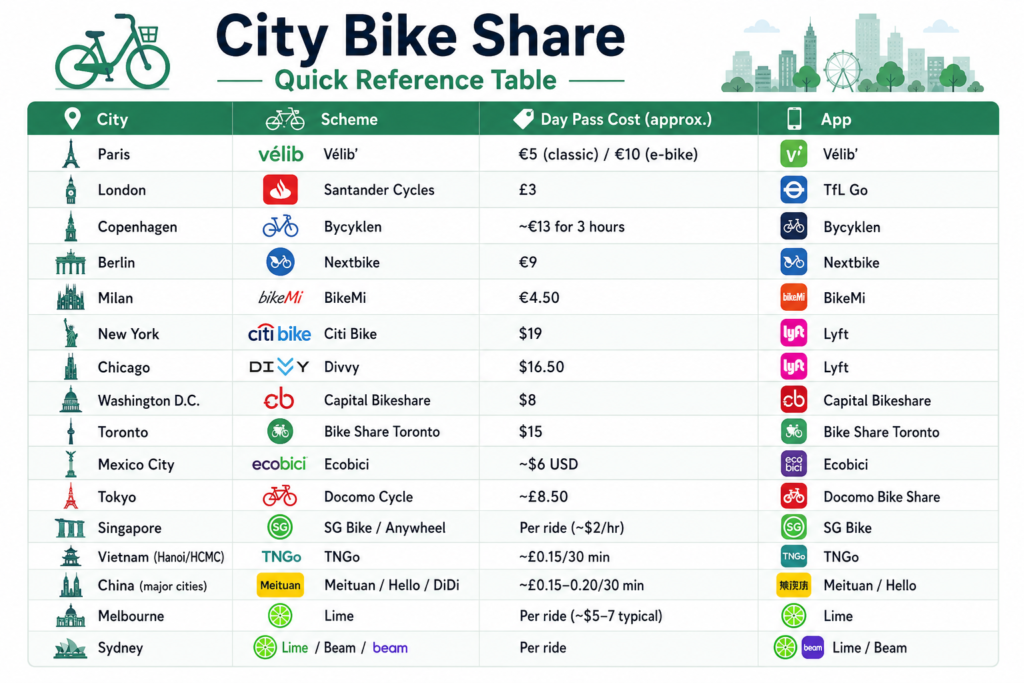
This guide covers over 30 cities across Europe, North America, Asia, Australia, and Latin America. For each one you’ll find the scheme name, the app to download, what a day pass costs, and what’s worth knowing before you ride.

What Is City Bike Share — and Why Should Budget Travellers Use It?
City bike share systems are publicly operated (or city-licensed) networks of docked bicycles placed at fixed stations across a city. You pay a small fee, unlock a bike via app or card, ride to your destination, and dock it at any station. You’re not renting a bike for a full day — you’re paying for short trips, typically with the first 30–45 minutes free or included in a day pass.
For budget travellers, the maths are compelling. A day metro pass in Paris costs around €9. A day on Vélib’ costs €5. In London, a single Tube journey costs £3.40. Santander Cycles charges £3 for unlimited 30-minute rides all day. If you’re spending more than an hour on public transport in any major city, bike share is almost always cheaper.
The other reason to use it: you see more. Riding across a city at street level, stopping when you want to, taking a different route because the street looks interesting — that’s not something you get on the metro.
============================================================ –>Free Guide · Instant Download
50 Genuinely Free
Travel Experiences
Named, located, and verified — no catches, no upsells. Get the full guide plus one smart, specific travel idea in your inbox every month.
No spam, ever. Unsubscribe in one click.
Europe
🇫🇷 Paris — Vélib’ Métropole
App: Vélib’ (iOS/Android) | Website: velib-metropole.fr
Vélib’ is one of the biggest and best-run schemes in the world. Over 20,000 bikes — including a large fleet of electric-assist bikes — spread across 1,400+ stations throughout Paris and the surrounding communes. The network is dense enough that you’re rarely more than a few minutes’ walk from a station.
Pricing:
- V-Libre day pass: €5 (unlimited 30-minute trips on classic bikes)
- V-Électrik day pass: €10 (unlimited 30-minute trips on electric bikes)
- Weekly pass: €25 classic / €35 electric
Worth knowing: Electric bikes (marked with a yellow lightning bolt) cost a bit more per trip but are the only sensible option for the Butte Montmartre area and anywhere near the Seine hills. Download the app before you arrive — registration requires a bank card and can take a few minutes. The bikes are heavy but the station density means you’ll never be far from a drop-off.
Best route: Bastille → Notre-Dame → Saint-Germain-des-Prés → Musée d’Orsay. Entirely flat, entirely scenic, entirely free of tourists on tour buses.
🇬🇧 London — Santander Cycles
App: TfL Go (iOS/Android) or use the docking station terminal | Website: tfl.gov.uk/modes/cycling/santander-cycles
The bikes Londoners call “Boris Bikes” after their politically motivated launch. There are now over 14,000 bikes and 800+ docking stations across central London, stretching from Hammersmith in the west to Victoria Park in the east.
Pricing:
- £3 access fee per day (covers unlimited 30-minute rides)
- Each additional 30 minutes: £1.65
- Most journeys between central docking stations take under 30 minutes
Worth knowing: The access fee covers unlimited same-day rides as long as each individual journey is under 30 minutes. This is more than enough for sightseeing — the city centre isn’t as large as it looks on a map, and most landmark-to-landmark rides take 10–20 minutes. Avoid the A roads (especially around Elephant & Castle). The Embankment, Regent’s Canal towpath, and the parks are the routes to prioritise. You don’t need to download an app — hire directly at any docking terminal with a contactless card.
Best route: Waterloo Bridge → along the Embankment → Westminster → St James’s Park → Buckingham Palace → Hyde Park → Kensington Gardens.
🇩🇰 Copenhagen — Bycyklen
App: Bycyklen (iOS/Android) | Website: bycyklen.dk
Copenhagen is one of the world’s most cycling-friendly cities, but the tourist-facing scheme — Bycyklen — is electric-only, tablet-equipped, and slightly pricier than its equivalents elsewhere. That said, the city’s cycling infrastructure is exceptional — dedicated lanes on almost every major street and courteous drivers who are genuinely used to bikes.
Pricing:
- 30 DKK/hour (approximately €4/hour)
- 95 DKK for 3 hours (approximately €13)
- Monthly membership: 70 DKK/month
Worth knowing: Bycyklen bikes have a built-in tablet with GPS navigation — useful for navigating a new city. For longer rides, the hourly rate adds up. If you’re staying more than a couple of days, consider renting a bike from a local shop (usually 80–120 DKK/day) which works out cheaper. That said, for a half-day of sightseeing, Bycyklen is perfectly convenient.
🇳🇱 Amsterdam — OV-fiets
App: NS (Dutch Railways app, iOS/Android) | Website: ns.nl/en/door-to-door/ov-fiets
A note on Amsterdam: the city has a bike-hire culture so deeply embedded that the tourist-facing “bike share” options are mostly private rental shops rather than a London or Paris style municipal docking scheme. OV-fiets is the closest equivalent — it’s part of the national Dutch public transport system, with bikes available at train stations across the Netherlands including Amsterdam Centraal, Amsterdam Sloterdijk, and Amsterdam Zuid.
Pricing:
- €4.25 for 24 hours
- Requires a Dutch OV-chipkaart (public transport card) — obtainable at any train station for €7.50 deposit
Worth knowing: OV-fiets is best for day-trippers or anyone arriving by train. For pure city cycling in Amsterdam, you’re better off with a local rental (try MacBike or Star Bikes, from €10/day). But if you’re already travelling by Dutch rail, OV-fiets is extremely good value for adding a cycling leg to your journey.
🇪🇸 Barcelona — Bicing
App: Bicing (iOS/Android) | Website: bicing.barcelona
Bicing is Barcelona’s municipal scheme — but it’s primarily designed for residents, not tourists. Membership is monthly or annual and requires a local bank account or credit card registered to a Spanish address. If you’re staying for a week or more and have a foreign card, you may still be able to sign up, but it’s not straightforward.
For tourists: Donkey Republic (donkey.bike) operates dockless bikes across Barcelona, available on a per-hour basis (approximately €1–2/hour) with no local card required. It’s more expensive than Bicing but genuinely accessible to visitors.
Worth knowing: Barcelona’s cycling infrastructure has improved dramatically — the Superblocks (Superilles) have added hundreds of protected bike lanes in the Eixample. The Passeig de Gràcia is now largely cyclable. For budget travellers, the combination of the metro and a couple of Donkey Republic rentals for specific routes covers most of the city affordably.
🇩🇪 Berlin — Nextbike / Tier
App: Nextbike (iOS/Android) or Tier (iOS/Android) | Website: nextbike.de
Berlin has a fragmented bike share ecosystem — no single dominant municipal scheme. Nextbike operates around 5,000 docked bikes across the city, while Tier (electric-focused) adds another layer. Deutsche Bahn’s Call a Bike scheme also still operates in some areas.
Pricing (Nextbike):
- €1 to unlock + €0.15/minute
- Day flat rate: €9
Worth knowing: Berlin is enormous — the distances between sights are much larger than in Paris or London. Bike share makes most sense for neighbourhood-level exploration (Mitte, Prenzlauer Berg, Friedrichshain are all very cyclable) rather than cross-city transit. Consider a full-day bike rental from a local shop (typically €12–15) if you’re planning a full day’s cycling.
🇮🇹 Milan — BikeMi
App: BikeMi (iOS/Android) | Website: bikemi.com
Milan’s BikeMi is a solid municipal scheme with around 3,600 bikes (including electric) at 280+ stations, concentrated in the central city. It’s well used by locals and increasingly popular with visitors.
Pricing:
- Day pass: €4.50 (30-minute trips included; e-bike trips: 30 cents each)
- Weekly pass: €9
Worth knowing: BikeMi works well for the Brera, Navigli, and Porta Romana areas. The Navigli canal district is particularly good for cycling — flat, scenic, and with minimal traffic on weekend mornings. Download the app and register before you arrive; there can be a SMS verification step that requires a working local or international number.

North America
🇺🇸 New York City — Citi Bike
App: Lyft (iOS/Android) — Citi Bike is operated by Lyft | Website: citibikenyc.com
Citi Bike is one of the largest and most developed bike share networks in the world. Over 25,000 bikes — including thousands of e-bikes — across more than 1,500 stations in Manhattan, Brooklyn, Queens, the Bronx, and Jersey City. The coverage is dense enough to use for real point-to-point trips, not just tourist loops.
Pricing:
- Single ride: $4.99 (classic) / $0.20/minute (e-bike, minimum $1)
- Day pass: $19 (unlimited 30-minute classic rides + $0.17/minute e-bike)
- 3-day pass: $29
Worth knowing: The e-bikes are genuinely useful in New York — the city is flatter than its reputation in Manhattan, but wind and distance make them worth the small surcharge. Dedicated bike lanes now cover most of the Lower East Side, Brooklyn Bridge Park, and Hudson River Greenway (the Manhattan waterfront path, which is entirely separated from traffic and one of the best urban cycling routes anywhere). Avoid midtown during rush hour. The Lyft app covers everything from unlocking to finding available bikes.
Best route for visitors: Hudson River Greenway from Battery Park to the George Washington Bridge — 13 miles of protected path with zero traffic.
🇺🇸 Chicago — Divvy
App: Lyft (iOS/Android) | Website: divvybikes.com
Chicago’s Divvy is part of the same Lyft-operated network as Citi Bike, with 800+ stations and over 16,000 bikes across the city and suburbs. The Chicago Lakefront Trail (18 miles of protected path along Lake Michigan) makes this one of the best cities in North America for bike share.
Pricing:
- Single ride: $1 to unlock + $0.17/minute
- Day pass: $16.50 (unlimited 3-hour rides)
- E-bike: $0.20/minute
Worth knowing: The Lakefront Trail is the essential Chicago cycling route — from Rogers Park in the north to South Shore in the south. The trail is separated from traffic for its entire length. Millennium Park, Navy Pier, and Museum Campus all have Divvy stations nearby. Chicago’s grid system makes navigation intuitive even without GPS.
🇺🇸 Washington D.C. — Capital Bikeshare
App: Capital Bikeshare (iOS/Android) | Website: capitalbikeshare.com
One of the most mature bike share systems in the US, with 700+ stations across D.C., Arlington, Alexandria, and surrounding Maryland suburbs. The flat terrain of central D.C. and the network of car-free paths along the National Mall and Rock Creek make this excellent for tourist use.
Pricing:
- Single ride: $1 unlock + $0.05/minute (classic) / $0.10/minute (e-bike)
- Day pass: $8 (unlimited 30-minute rides)
Worth knowing: The National Mall route — Lincoln Memorial → Washington Monument → Capitol Building — is entirely cyclable on the Mall’s inner paths and is stunning at sunrise before the crowds arrive. Rock Creek Park has dedicated cycling paths that give you a completely car-free escape from the city. Stations are dense around Dupont Circle, Georgetown, and Capitol Hill.
🇨🇦 Toronto — Bike Share Toronto
App: Bike Share Toronto (iOS/Android) | Website: bikesharetoronto.com
Toronto’s scheme runs year-round — yes, including winter — which says something about the robustness of the infrastructure. Over 7,000 bikes at 700+ stations, concentrated in the downtown core and extending into surrounding neighbourhoods.
Pricing:
- Day pass: $15 (unlimited 30-minute rides)
- 72-hour pass: $20
Worth knowing: The Martin Goodman Trail along the Lake Ontario waterfront is the best cycling route in the city — 56km of trail running from Etobicoke in the west to Scarborough in the east, with the city skyline behind you the whole way. The scheme has e-bikes available at most stations (marked in green on the app map) at a small surcharge per ride.
🇲🇽 Mexico City — Ecobici
App: Ecobici (iOS/Android) | Website: ecobici.cdmx.gob.mx
Mexico City’s Ecobici is one of the best bike share systems in Latin America — 6,800+ bikes across 480+ stations, concentrated in the central city (Roma, Condesa, Polanco, Centro Histórico). The system was expanded significantly during the pandemic and cycling infrastructure has improved substantially since.
Pricing:
- Day pass: MXN 115 (approximately $6 USD) — unlimited 45-minute rides
- Annual subscription: MXN 576 (approximately $30 USD)
Worth knowing: Ecobici’s 45-minute free trip window (longer than most schemes) makes it very practical for sightseeing. The Roma and Condesa neighbourhoods are almost perfectly flat and have dedicated cycling lanes (ciclovías) on most main streets. Sundays bring the Paseo Dominical — a car-free road circuit of over 50km through the city’s main avenues, popular with locals and excellent for cycling.
Asia
🇯🇵 Tokyo — various municipal schemes + Docomo Bike Share
App: Docomo Bike Share (iOS/Android) | Website: docomo-cycle.jp/english
Tokyo doesn’t have a single city-wide bike share scheme — instead, it operates through a patchwork of ward-level (district-level) systems, many run or supported by Docomo Cycle (NTT Docomo’s cycling arm). The most tourist-relevant areas — Minato, Chiyoda, Shinjuku, Shibuya, Sumida — all have Docomo-operated stations.
Pricing:
- 165 yen per 30 minutes
- Day pass: 1,650 yen (approximately £8.50 / $11)
Worth knowing: The key thing to understand about Tokyo cycling is the rule: bicycles are supposed to be ridden on the pavement (sidewalk) in many areas, not the road. The cities in the west are not used to cyclists in traffic. That said, the Sumida River path, Yoyogi Park, and the Imperial Palace outer loop are excellent flat cycling routes. E-bikes are available at most stations — very helpful given Tokyo’s occasional hills and summer heat.
Useful tip: Stations from different ward systems aren’t always interchangeable — a bike picked up in Minato ward should be returned to a Minato ward station unless you buy a cross-ward pass. The app makes this clear.
🇸🇬 Singapore — SG Bike / Anywheel
App: SG Bike (iOS/Android) or Anywheel (iOS/Android) | Website: sgbike.com.sg
Singapore operates a dockless bike share model — no fixed docking stations. Instead, bikes can be parked (and collected) anywhere within designated zones, with GPS tracking via the app. SG Bike and Anywheel are the two main operators after the collapse of earlier services like oBike and ofo.
Pricing (SG Bike):
- $0.50 per 15 minutes
- No day pass — charged per ride
Worth knowing: Singapore’s park connector network (PCN) is exceptional — 300km of dedicated cycling paths linking parks, nature reserves, and waterfronts. East Coast Park, the Southern Ridges, and the Kallang River route are all excellent. The tropical heat makes early morning (before 9am) or evening (after 5pm) the practical riding times. Helmets are recommended but not legally required for bike share users.
🇹🇭 Bangkok — various / Obike + local schemes
App: Varies by area — check Palang Thai or Anywheel
Bangkok’s bike share ecosystem is patchy and evolving. Several short-term schemes have launched and collapsed. The most reliable options are currently: local rental shops near tourist areas (Rattanakosin Island / Old Town area, Chatuchak Park), and the Bangkok Metropolitan Administration (BMA) scheme operating near Bang Sue and some riverfront areas.
For practical cycling: The Chao Phraya River Express boat combined with cycling along the riverside is one of the best budget ways to explore Bangkok. Some neighbourhoods (Phra Nakhon, Thonburi riverside) are excellent for cycling in the early morning. Avoid during midday heat.
Honest assessment: Bangkok is not yet a reliable bike share city for tourists. Stick to the BTS Skytrain and Khlong boats for main transit, and rent a local bike for neighbourhood exploration rather than relying on an app-based scheme.
🇻🇳 Hanoi & Ho Chi Minh City — Mobike / TNGo
App: TNGo (iOS/Android) | Website: tngo.vn
Vietnam has seen rapid growth in bike share since 2020. TNGo operates in both Hanoi and Ho Chi Minh City (HCMC) with dockless e-bikes and regular bikes.
Pricing:
- From 5,000 VND per 30 minutes (approximately £0.15 / $0.20)
- Day pass: varies by city, typically 20,000–35,000 VND
Worth knowing: This is excellent value even by budget travel standards. In Hanoi, the Old Quarter and Hoan Kiem Lake area are well-served. In HCMC, the Bình Thạnh and District 1 riverfront areas are most cyclable. A Vietnamese phone number is required to register — most tourist SIM cards work. Traffic in both cities is intense; ride defensively and use the quieter back streets.
🇨🇳 Major Chinese Cities — Meituan / Hello / Didi
Apps: Meituan Bike (美团单车), Hello Bike (哈啰出行), Didi Bike (DiDi app)
China has the world’s most developed bike share ecosystem by volume — literally hundreds of millions of dockless bikes across thousands of cities. The three main operators are Meituan, Hello Bike, and DiDi Bike. In most major cities (Beijing, Shanghai, Chengdu, Shenzhen, Guangzhou), coverage is near-total.
Pricing:
- Around 1.5–2 yuan per 30 minutes (approximately £0.15–0.20)
- Monthly passes: 15–25 yuan (approximately £1.60–2.70)
Worth knowing: Registration requires WeChat Pay or Alipay, both of which now accept international cards (Visa/Mastercard) via their apps. This takes some setup — do it before you arrive, or ask your accommodation to help. Once registered, bike share in China is absurdly cheap and genuinely useful. In Shanghai, the French Concession and Jing’an neighbourhoods are excellent for cycling. In Beijing, the Olympic Park area and Houhai Lake district are highlights.

Australia
🇦🇺 Melbourne — Melbourne Bike Share (discontinued) / Lime
App: Lime (iOS/Android) | Website: li.me
Melbourne’s original docked bike share scheme closed in 2019. The city is now served by Lime’s dockless e-bike network, with 1,500+ bikes across the inner city and inner suburbs.
Pricing:
- $1 to unlock + $0.45/minute
- Day pass: not currently available — charged per ride
Worth knowing: Lime is more expensive than traditional docked schemes, but Melbourne’s city centre is compact and most tourist rides are under 10 minutes. The Yarra River trail, the Royal Botanic Gardens, and the city’s cycling-friendly grid make this practical for sightseeing. Helmets are legally required in Victoria and are attached to each Lime bike (though quality varies — bring your own if you’re planning longer rides).
🇦🇺 Sydney — Lime / Beam
App: Lime (iOS/Android) or Beam (iOS/Android) | Website: li.me or beam.global
Sydney has no single municipal scheme. Lime and Beam both operate dockless e-bikes across the inner city and eastern suburbs.
Pricing (Lime): $1 to unlock + $0.45/minute
Worth knowing: Sydney’s hills make e-bikes far more practical than regular bikes for most tourist routes. The Bondi to Coogee coastal walk path allows cycling in sections. Manly (accessed by ferry) has good bike paths and is more cyclable than central Sydney. Check both Lime and Beam apps for availability — coverage varies by area.
Tips for Using Bike Share as a Budget Traveller
1. Download the app before you arrive. Most schemes require registration with a card before you can unlock a bike. Do this on your hotel wifi, not standing at a docking station in the rain.
2. Understand the 30-minute rule. Most docked bike share schemes include unlimited rides with each trip under 30 minutes. This is enough for almost every point-to-point tourist journey. The trick is: if you’re not sure you’ll make it in time, dock and redock. You reset the clock every time you dock a bike at a station.
3. Use the map to plan docking stations, not just destinations. Before setting off, check that there’s a docking station near your destination. If the nearest one is 400m away from where you need to be, plan for that walk.
4. Electric bikes are usually worth the surcharge. If you’re cycling in an unfamiliar city with luggage, in summer heat, or over any kind of gradient, the electric assist dramatically reduces the chance of arriving at your destination sweaty and exhausted. For sightseeing, that matters.
5. The best cycling routes in any city are almost never on the main tourist map. Riverside paths, canal routes, park circuits, and converted rail trails are almost always quieter, more scenic, and more enjoyable than cycling along the main roads. A five-minute search for “[city] cycling route map” will usually turn up the locals’ knowledge.
6. Compare the day pass cost against public transport. In most European and North American cities, a day on bike share costs less than two metro journeys. If you’re spending a full day sightseeing, bike share wins on cost almost every time.
What’s Missing From Your City?
This guide covers the schemes most useful to international visitors, but there are hundreds more worth knowing about: Oslo Bysykkel (excellent in Norway’s capital), Veturilo in Warsaw, Next Bike across 20+ Central European cities, Indego in Philadelphia, Bay Wheels in San Francisco, Bixi in Montreal, and the vast network of schemes across India and Southeast Asia.
If there’s a city you’re travelling to that isn’t on this list, the fastest way to check: search “[city name] bike share” or “[city name] bicicleta publica” — every scheme worth using has a website, and most have English-language tourist information. The existence of the scheme is almost never the problem; the problem is usually knowing what it’s called and what app to download.