Couchsurfing isn’t what it was in 2012. The app now charges a membership fee in most countries, verification has tightened, and a lot of the original community left when that fee arrived. But the core idea — sleeping on a stranger’s sofa for free, in exchange for conversation and the occasional bottle of wine — still works. I’ve used it on and off for years, most recently in Lisbon and Ljubljana. Here’s the honest version, not the recruitment-page version.

What Couchsurfing actually costs now
Couchsurfing introduced a membership fee back in 2020, and by 2026 it’s a fixed part of using the platform in most regions — typically somewhere in the low-to-mid teens per year, depending on your country. Messaging hosts and browsing profiles requires it. This is the single biggest thing that’s changed, and it’s worth knowing before you download the app expecting the free-for-everyone version from a decade ago.
Is it still worth paying for? If you’re a couchsurfing regular — three or more stays a year — yes, easily. The fee is less than one night in a mid-range hostel. If you’re testing it once for a single weekend, the maths is closer, and Trusted Housesitters or Workaway-style accommodation swaps might make more sense depending on your trip.
The Complete Guide to Budget Accommodation: From Hostels to Capsule Hotels
============================================================ –>Free Guide · Instant Download
50 Genuinely Free
Travel Experiences
Named, located, and verified — no catches, no upsells. Get the full guide plus one smart, specific travel idea in your inbox every month.
No spam, ever. Unsubscribe in one click.
Is Couchsurfing safe in 2026?
Yes, with real caveats — the same caveats that applied in 2016, just easier to check now.
The platform verifies identity documents and phone numbers, and every host and guest profile carries public references from past stays. That reference history is the actual safety mechanism — not the verification badge, which just confirms someone is who they say they are, not that they’re a good host.

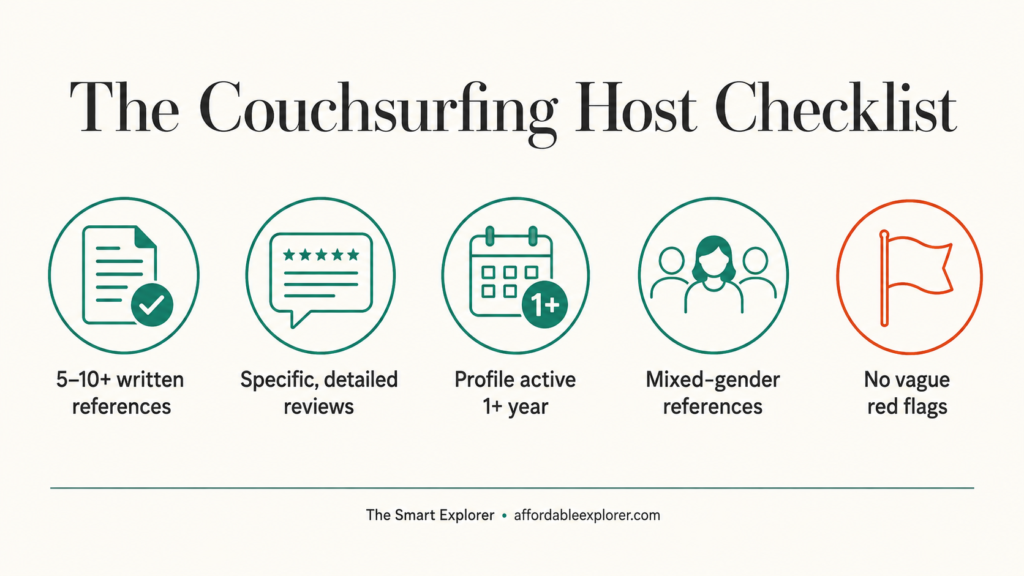
What I actually check before saying yes to a host:
- At least 5–10 written references, not just a star rating
- References that mention specific details (a shared meal, a city tip, a conversation) rather than generic one-liners, which are sometimes traded between friends
- A profile that’s been active for more than a year
- References from both men and women, if the host is male and I’m travelling solo
- No mention anywhere in the references of pressure, discomfort, or anything vague that reads like it’s been softened
If a profile has glowing five-star reviews but they’re all from the last two months, I skip it. New accounts aren’t automatically unsafe, but they’re unverified in the way that actually matters.
Practical safety habits that make the biggest difference:
- Tell one person outside the trip exactly where you’re staying, with the host’s name and profile link
- Video call before you arrive if it’s a longer stay — it takes two minutes and tells you a lot
- Arrange to meet somewhere public first if you’re at all unsure, rather than going straight to the address
- Trust the exit instinct. If something feels off when you arrive, leave. A wasted night’s booking fee elsewhere is nothing compared to staying somewhere you don’t want to be
None of this is unique to Couchsurfing — it’s the same logic as vetting any stranger’s spare room, including Airbnb hosts. Couchsurfing just makes you do more of the legwork yourself, because there’s no company standing behind the transaction the way there is with a paid booking platform.

Who Couchsurfing actually works for
It’s not really an accommodation strategy — it’s a way to meet people, and the free bed is the byproduct. If what you want is a guaranteed, predictable, no-conversation-required place to sleep, book a hostel. If you want a local’s perspective on a city, an invitation to dinner, or someone to show you the neighbourhood nobody writes about, Couchsurfing delivers something a hostel dorm never will.
It works best for:
- Solo travellers with flexible plans who don’t mind a bit of social effort
- People staying in a city for 2–4 nights, long enough to actually get something out of the connection
- Anyone travelling on a route with limited hostel infrastructure, where a local host is genuinely the best option available
It works less well for:
- Anyone who wants total control over their schedule — you’re a guest in someone’s home, not a customer
- Very short layover-style stays, where there’s no time to build the exchange that makes it worthwhile
- Groups of three or more, since most hosts only have space for one or two guests
The honest verdict
Couchsurfing in 2026 is smaller, more curated, and no longer free to use — but the stays that happen through it are, if anything, more genuine than they were in the platform’s crowded early years. It’s not a replacement for hostels or budget hotels on every trip. It’s a specific tool for a specific kind of traveller, and when it lands, it’s one of the best free experiences travel has to offer.
If you’re building a mixed accommodation strategy for a longer trip, Couchsurfing pairs well with house-sitting for stretches when you want your own space, and with a hostel for cities where you just need a bed and a shower. None of these should carry your whole trip on their own — that’s the point of having options.