The Budget Traveller’s Transport Guide
15 min read · Getting Around
Transport is where budget travellers haemorrhage money without realising it. A taxi from the airport, a tourist hop-on hop-off bus, a few Ubers across a week — and suddenly you’ve spent £150 on getting around a city that had a perfectly good metro the whole time.
I’ve been travelling on a tight budget for over a decade. In that time, I’ve ridden city bikes in Bangkok at 5am, figured out the night bus system in Budapest at midnight, walked across Lisbon in the rain rather than pay for a tram, and talked my way into tourist transport cards that locals don’t advertise. Here’s everything I’ve learned about getting around any city for almost nothing.
============================================================ –>Free Guide · Instant Download
50 Genuinely Free
Travel Experiences
Named, located, and verified — no catches, no upsells. Get the full guide plus one smart, specific travel idea in your inbox every month.
No spam, ever. Unsubscribe in one click.
This guide covers every method — city bikes, public transport, tourist cards, overnight buses, walking, and the airport transfer tricks that nobody tells you — with specific examples from cities I’ve actually used them in.
| ✓ QUICK WIN If you only do one thing: look up your city’s bike share scheme before you arrive. In most major cities, the first 30–60 minutes is free. You can cover a huge amount of ground at zero cost. |
1. City Bike Share: The Most Underrated Budget Transport Tool
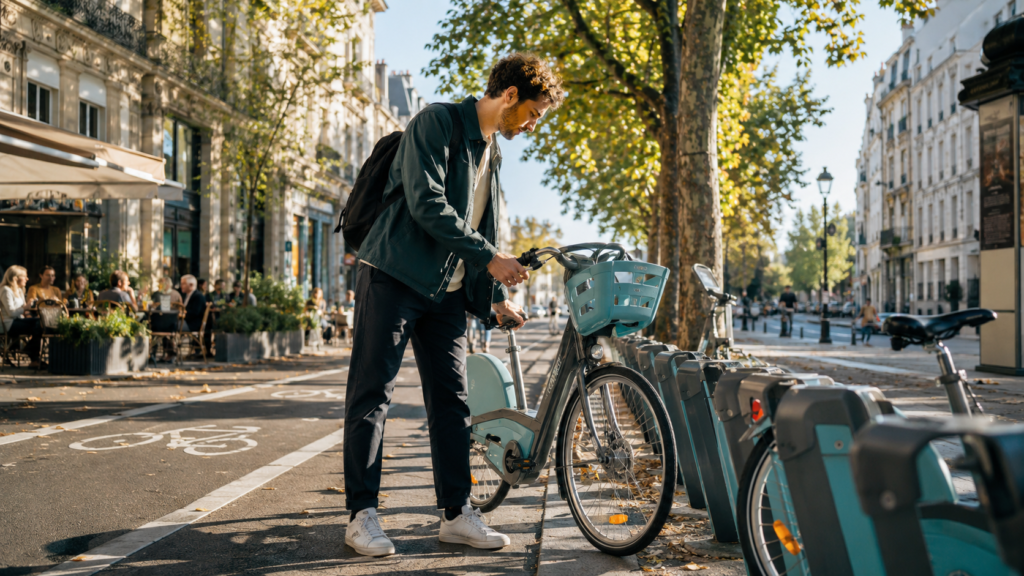
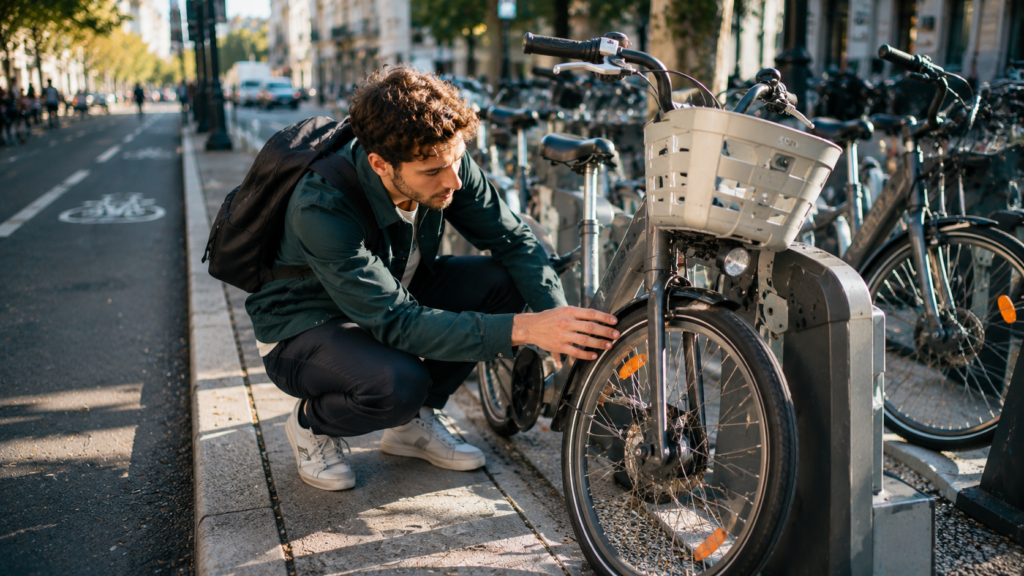
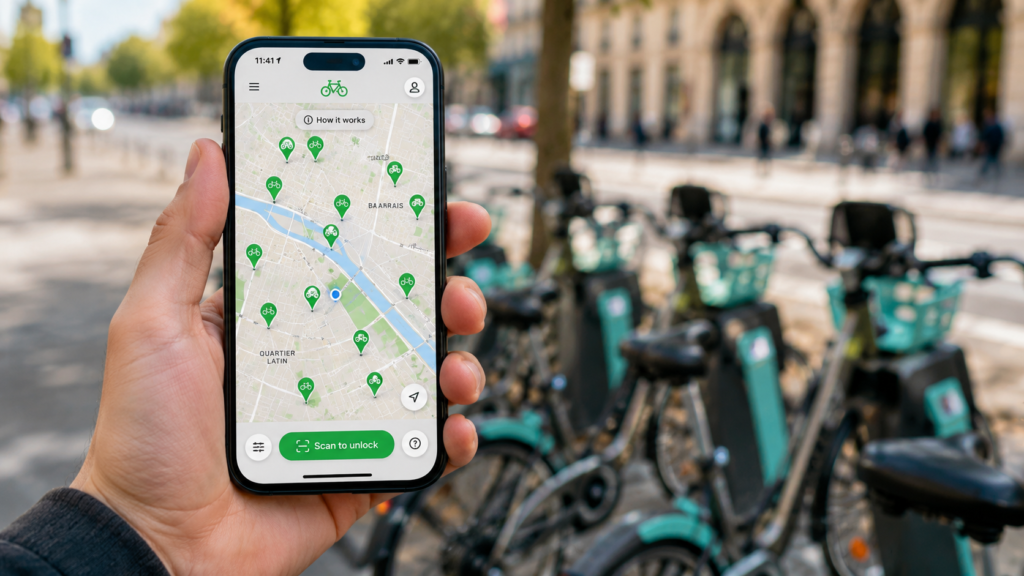
Let me start here because it’s the thing most budget travellers overlook entirely. Nearly every major city in the world now has a public bike share scheme, and in the majority of them, the first 30–60 minutes of every ride is free or costs pennies.
That 30-minute window is almost always enough. City centres are compact. The distance between the Louvre and Notre Dame in Paris? 1.4km — twelve minutes by bike. From downtown Chicago’s Millennium Park to the Art Institute? A four-minute ride. In Bangkok, you can cross most tourist areas in under 20 minutes on a flat bike.
I’ve done entire city days — museums, markets, viewpoints, lunch spots — using nothing but the free windows on a bike share app. It takes planning, but it works.
How city bike share pricing actually works
Almost every bike share scheme uses the same model:
- You pay a daily or weekly access fee (usually £1–4 per day)
- Every individual ride under 30–45 minutes is then free
- You pay extra per minute beyond that window (typically 10–25p/minute)
The trick is to dock the bike before the window closes, wait a minute, and start a new ride. Locals do this constantly. You’re not breaking any rules — that’s exactly how the system is designed to work.
The best city bike share schemes in the world
Here’s a practical reference table for cities I’ve personally used or researched in depth:
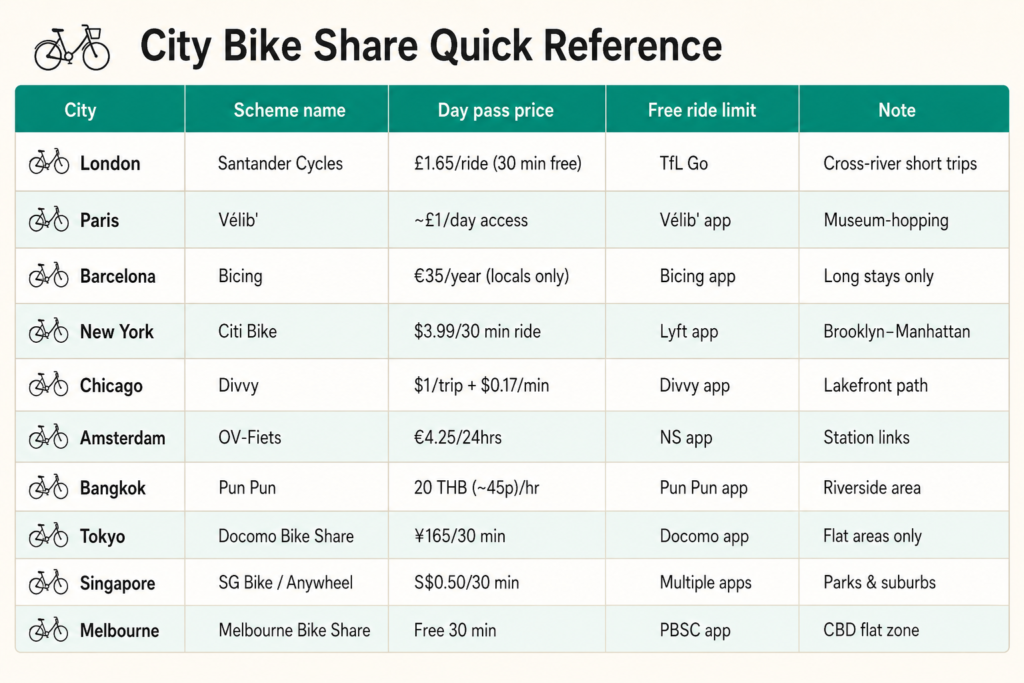
| ⚠ BANGKOK TIP The Pun Pun scheme in Bangkok is legitimately brilliant and almost no tourists use it. The bikes are docked near major BTS stations and tourist areas. Combine it with the BTS Skytrain for fast, cheap city crossings that would cost 3–4x more by tuk-tuk. |
E-bikes and scooter shares: worth it?
Many cities now have dockless e-bike or e-scooter schemes alongside traditional bike share. My honest view: they’re rarely worth it for budget travel. They charge by the minute (typically 20–35p/minute), have no free window, and the costs add up fast.
The exception is longer, hilly journeys where a regular bike would be impractical. In Lisbon (deeply hilly) or Edinburgh, an e-bike for a specific route makes sense. For general city getting-around, stick to traditional bike share.
2. Public Transport: The System That Already Exists
Every city in the world has a public transport system. Most budget travellers either ignore it (relying on taxis or Uber) or treat it as a backup. Flipping that — making public transport your default and everything else the exception — saves hundreds of pounds on a two-week trip.
The challenge is the learning curve. Different cities have completely different systems, payment methods, and rules. Here’s how to figure out any system in under an hour.
How to crack any city’s public transport in 60 minutes
- Search ‘[city name] public transport for tourists Reddit’ — Reddit threads are more honest than official tourist guides and usually more current
- Download the city’s official app before you arrive (most cities have one — London uses TfL Go, Paris uses RATP, Tokyo uses Tokyo Metro app)
- Look for contactless payment: most European and Asian cities now accept contactless bank cards on metros and buses — no need to buy a separate card
- Find the airport line first: airport express trains are almost always the cheapest way in from the airport and run on standard metro infrastructure
- Ask the hostel reception what locals use — they’ll tell you the specific quirks (e.g., ‘the metro doesn’t go there, take bus 42’)
Which cities have the best public transport for budget travellers?
From my experience, these cities stand out:
- Tokyo: Extraordinarily well-organised. IC card (Suica or Pasmo) works on everything. Buses, metro, local trains — one card, one tap. Expensive compared to Southeast Asia but excellent value for what it covers.
- Budapest: Brilliant and cheap. A 24-hour travelcard costs around £5 and covers all trams, buses, and metro lines. One of Europe’s best transport bargains.
- Bangkok: BTS Skytrain and MRT metro are clean, air-conditioned, and very cheap (typically 15–60 THB per journey). Avoid tuk-tuks for anything over a short distance — they’ll charge tourists 10x the BTS price.
- Berlin: The ABC zones system feels complicated but isn’t. A day ticket (Tagesticket) covers all public transport including the S-Bahn connections to the airports. Germans take public transport seriously.
- New York: The subway is 24/7 and a single ride is $2.90. Get an OMNY-enabled MetroCard or just tap contactless. Ignore the cabs.
- Kuala Lumpur: Surprisingly good once you understand it. Multiple overlapping systems (LRT, MRT, Monorail, KTM) that all take the same Touch ‘n Go card.
| ✓ THE CONTACTLESS REVOLUTION If you’re travelling in Europe or East Asia, check whether your city accepts contactless bank card payment on public transport before you buy any tourist card. London, Paris, Barcelona, Madrid, Prague, Budapest, Tokyo, and dozens of others all accept tap-and-go. It’s almost always the cheapest and most flexible option. |
Cities where public transport is genuinely difficult
Not everywhere is Tokyo. Some cities require more navigation:
- Los Angeles: The metro exists and is actually decent, but LA’s spread means you’ll often need ride-shares or a car for the last mile. Budget accordingly.
- Cairo: The metro is cheap but limited. Above ground, taxis are common but metered taxis are rare — negotiate in advance or use ride-share apps like Careem.
- Marrakech: Virtually no tourist-usable public transport in the medina. Walking and negotiated petit taxis are your tools here.
- Most of rural Southeast Asia: Long-tail boats, songthaews, and local buses exist but require research. This is where hostel reception advice is invaluable.
3. Tourist Travel Cards: When They’re Worth It (And When They’re Not)
Every major tourist city sells some version of a transport card promising unlimited travel. Before you buy one, do the maths. Many are genuinely good value. Some are tourist traps.
The quick calculation
Take the card’s price. Divide by the individual journey cost. That tells you how many journeys you need to make before the card saves money. Then be honest about whether you’ll actually make that many.
Example: Budapest’s 24-hour travelcard costs around 2,300 HUF (~£5.30). A single ticket costs 450 HUF (~£1). You need to make 6 journeys in 24 hours to break even. If you’re doing a lot in one day, that’s very achievable. If you’re spending the afternoon at a museum, probably not.
City-by-city card verdicts
- London Oyster / contactless — Worth it. Cap system means you never pay more than the daily maximum regardless of how many journeys. Just use your contactless card.
- Paris Navigo Découverte (weekly) — Excellent if you’re staying a full week. Covers unlimited travel on all zones. Buy Monday, use until Sunday night.
- Tokyo IC card (Suica/Pasmo) — Not a discount card, but essential for convenience. Works on everything including JR lines and buses.
- Barcelona Hola BCN card — Usually worth it for 2+ days. Covers metro, buses, and airport connections.
- Rome 48/72hr card — Marginal. Rome’s centre is walkable and tourist sights cluster. Calculate carefully.
- Amsterdam I Amsterdam City Card — Usually not worth it for transport alone. Factor in museum discounts to decide.
- Hop-on hop-off bus, anywhere — Almost never worth it for budget travellers. Expensive and slow. Take public transport instead.
4. The Airport Transfer: The Expensive Mistake Everyone Makes
The taxi from the airport is where I see even experienced travellers lose money. Airports are specifically designed to make taxis look like the obvious choice. They’re not.
With almost no exceptions, taking public transport from the airport into the city is cheaper, faster (avoiding traffic), and more reliable than a taxi or pre-booked transfer.
Airport transport options, ranked by cost
From cheapest to most expensive, for most cities:
- City bus or coach — Often £1–5 and runs from outside the terminal. Slow but very cheap.
- Metro or city train — Usually £3–15. Fast, reliable, no traffic. This is almost always my recommendation.
- Airport express train — Premium-priced metro variant (e.g., Heathrow Express at £25 vs Tube at £6). Not worth it unless time is critical.
- Ride-share (Uber/Lyft/Bolt) — Surge pricing at airports. Useful at night when other options stop.
- Pre-booked transfer — Convenient for groups but expensive. Only makes sense splitting 3–4 ways.
- Airport taxi — Avoid. Fixed-rate overpricing at most major airports.
Specific airport examples that trip people up
- London Heathrow: Take the Piccadilly Line (£6) not the Heathrow Express (£25). Same destination, one-fifth of the price.
- Bangkok Suvarnabhumi: The Airport Rail Link to Phaya Thai is 45 baht (about £1). The official taxis cost 200–400 baht plus expressway toll.
- New York JFK: The AirTrain + Subway combination costs $8.75. Taxis run $52 flat rate (not including tolls and tip).
- Rome Fiumicino: The Leonardo Express (direct to Termini) costs €14. The regional FL1 train stops more but costs €8. Taxis are fixed at €48.
- Tokyo Narita: The N’EX costs around ¥3,000 but the Keisei Skyliner to Ueno is ¥2,520. The basic Keisei Limited Express is just ¥1,340.
| ✓ NIGHT ARRIVALS STRATEGY If you arrive late at night when public transport has stopped, Bolt or local ride-share apps are almost always cheaper than the taxi rank. Download the app before you land and set your destination before leaving the terminal. |
5. Night Buses and Overnight Transport: Free Accommodation in Motion
Here’s the reframe that changed how I plan long trips: an overnight bus or train isn’t just transport — it’s a night’s accommodation you don’t have to pay for. A 10-hour overnight bus from Bangkok to Chiang Mai costs £10–15. A hostel in Chiang Mai costs £8–15 per night. You’ve essentially travelled for free.
Where overnight transport works best
- Southeast Asia: The overnight bus network is excellent. Bangkok–Chiang Mai, Bangkok–Vientiane, Ho Chi Minh City–Hanoi (multiple stops), Kuala Lumpur–Hat Yai. Comfortable sleeper buses with reclining seats, air con, and sometimes blankets.
- Eastern Europe: Night trains are a genuine bargain. Budapest–Bucharest, Warsaw–Prague, Vienna–Kraków. Book a couchette for a bed, not just a seat.
- India: The overnight train network is extraordinary. Book second-class AC sleeper (2AC or 3AC) rather than first class — comfortable, cheap, and you arrive refreshed.
- Spain: The Trenhotel between Madrid and Lisbon was discontinued but regional night trains remain between Spanish cities. Worth checking RENFE for current options.
- Morocco: Overnight trains between Marrakech, Casablanca, and Tangier. Air-conditioned couchettes available.
How to book overnight transport without getting it wrong
- Use Bookaway or 12go.asia for Southeast Asian buses — they aggregate operators and show reviews
- For European trains, use Interrail/Eurail route planner or the Man in Seat 61 website — it’s old-fashioned but extraordinarily comprehensive
- Book couchettes not seats for any journey over 8 hours — the extra few pounds is worth it for actual sleep
- Arrive at the bus station 30 minutes early regardless of what the ticket says — departure times are approximate in most of Southeast Asia
- Pack a neck pillow and eye mask — you’ll actually sleep
6. Walking: The Zero-Cost Option That Most People Underuse
Walking gets overlooked as a transport strategy because it feels obvious. But I’ve consistently been surprised by how far you can cover on foot in a city when you plan for it.
Most major tourist cities are more compact than they appear on Google Maps. The historic centres of Rome, Prague, Lisbon, Marrakech, Istanbul, and Bangkok’s main tourist areas are all walkable in their entirety. Athens old town to the Acropolis is a 10-minute walk. The main museums of central Vienna are within 20 minutes of each other on foot.
Walking strategies that save money
- Plan your days geographically — group all the things you want to see in one area on the same day rather than crossing the city multiple times
- Use Google Maps offline — download the city map before you arrive so you can navigate without data
- Free walking tours are now available in almost every major city — search ‘[city] free walking tour’ and tip what you think it’s worth (typically £5–10 is fair)
- Walk between transport hubs rather than using taxis — the walk from Gare du Nord to the Pompidou Centre in Paris is 20 minutes and cuts through great neighbourhoods
- Use walking time to spot cheap lunch spots — you’ll find the places locals actually eat rather than the tourist strip restaurants
| ✓ FREE WALKING TOUR RECOMMENDATION Free walking tours are one of the best-value things in budget travel. You get a 2–3 hour orientation of the city from a local guide who knows it well, and you pay what you think it’s worth at the end. I use them in every new city. Search ‘[city] free walking tour’ — Sandemans operates in most European cities and the quality is consistently high. |
7. Getting Around Specific Regions: What Works Where
Southeast Asia
This region is genuinely easy and cheap to navigate once you know the system. Within cities: ride-share apps (Grab is the regional standard) are cheap and reliable — much cheaper than negotiated taxis. Between cities: buses and trains are comprehensive. Within small areas: motorbike taxis (helmet optional, chaos guaranteed) or songthaews (shared trucks).
Grab works across Thailand, Vietnam, Malaysia, Singapore, Cambodia, Myanmar, Indonesia, and the Philippines. Set it up before you go.
Europe
Public transport is generally excellent across Western and Central Europe. The major costs are intercity trains, which can be expensive if booked late. Book train travel 60–90 days in advance for cheap fares. Within cities, contactless payment now works almost everywhere.
For budget intercity travel: FlixBus covers almost all of Europe and is remarkably cheap (London to Paris from £5 if booked early). Blablacar rideshare is even cheaper for flexible travellers.
East Africa
Within major cities like Nairobi, Kampala, and Dar es Salaam, matatu minibuses are the local standard — very cheap, sometimes chaotic, and an experience in themselves. For longer intercity routes, coach companies like Dar Express or Easy Coach Kenya run reliable scheduled services for a few pounds.
Bolt (the Uber competitor) now operates in most major East African cities and is far cheaper than negotiating with street-hailing taxis.
South America
Bus travel is the backbone of South American budget travel and the overnight bus network is extraordinary. Peru, Bolivia, Argentina, and Chile all have comfortable sleeper bus services (called ‘cama’ buses) that cover huge distances cheaply. Buenos Aires to Santiago is 20 hours by bus and costs a fraction of a flight. Bogotá to Cartagena is 22 hours but the road journey through the Colombian countryside is worth it.

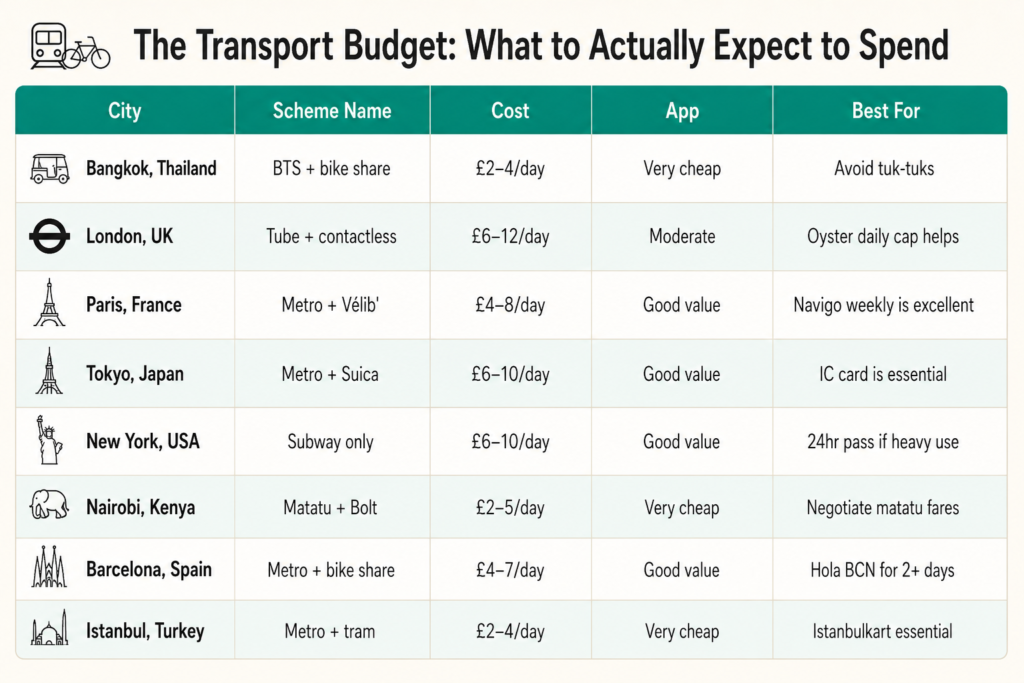
8. The Transport Budget: What to Actually Expect to Spend
Estimates for daily transport costs, assuming you’re using budget options intelligently:
The Smart Summary
Getting around any city cheaply isn’t complicated — it just requires doing the research before you arrive rather than improvising when you’re tired at an airport. The hierarchy I use:
- Walk first — if it’s under 25 minutes on foot, I walk
- Bike share second — for distances 1–5km, bike share is almost always free or near-free
- Public transport third — metro or bus for anything further or in bad weather
- Ride-share fourth — at night, with luggage, or when public transport has stopped
- Taxi never — unless I’m in a city with no other option and it’s already negotiated
Apply this hierarchy consistently and transport stops being a budget black hole. The money you save goes on the actual experiences — which is the whole point.