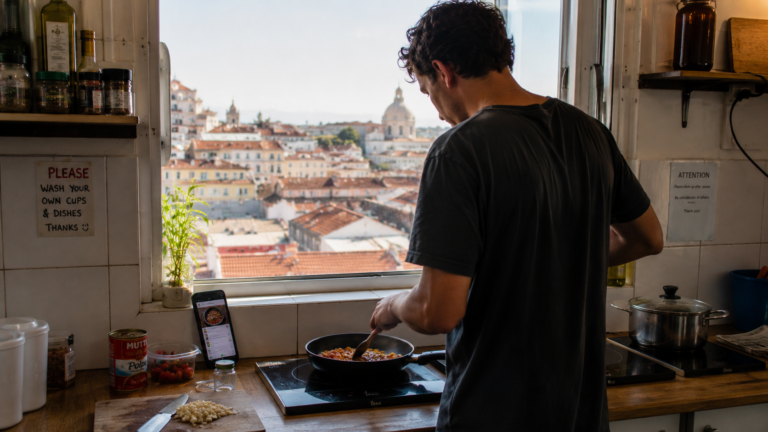
Getting around a city is one of the biggest hidden costs of travel. Flights and accommodation get all the attention, but a week of taxis or tourist shuttles can blow £100 out of your budget without you noticing. The good news: almost every major city in the world has genuinely affordable public transport options for visitors — you just need to know what to look for before you arrive.
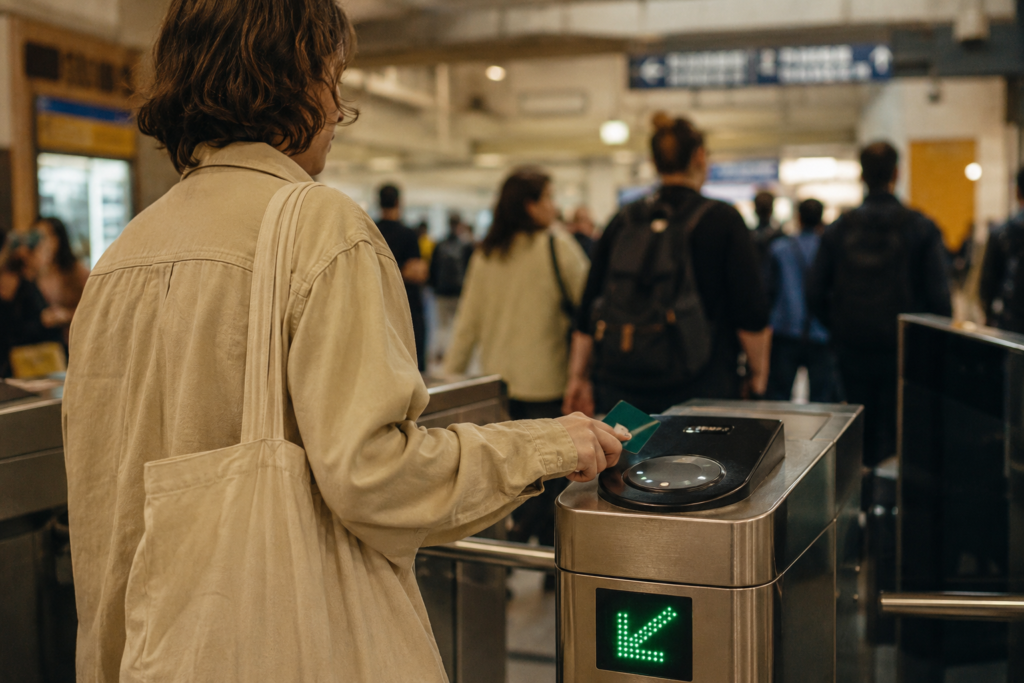
This guide covers the best free and cheap public transport options in cities across Europe, Asia, the Americas, and Australia. For each city, I have looked at tourist travel cards, free shuttle services, bike share schemes, and any quirks worth knowing. No fluff, no tourist brochure — just what actually saves money.
Europe
London, UK
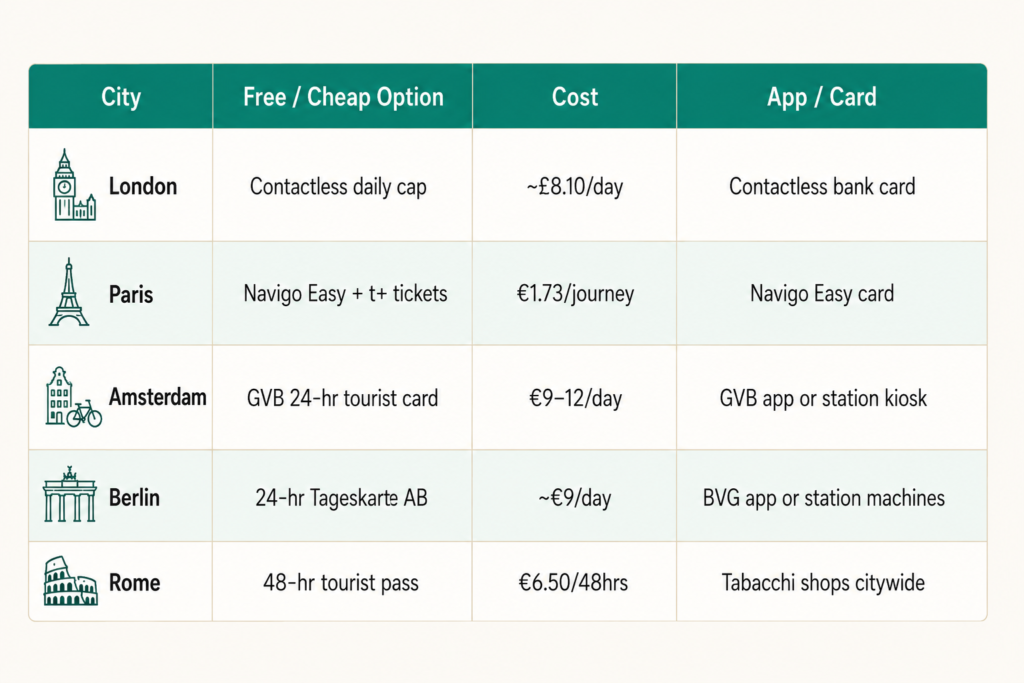
London has a reputation for expensive transport, and on the face of it that is fair — a single Underground journey can cost over £3.50 on a contactless card. But for tourists, the Oyster or contactless system has a daily price cap that kicks in after a few journeys, which makes a full day of travel considerably cheaper than buying individual tickets.
Daily cap: Around £8.10 for Zones 1–2 (covers almost all central London). Pay with a contactless bank card — no setup needed.
============================================================ –>Free Guide · Instant Download
50 Genuinely Free
Travel Experiences
Named, located, and verified — no catches, no upsells. Get the full guide plus one smart, specific travel idea in your inbox every month.
No spam, ever. Unsubscribe in one click.
Free option: The Thames Clipper river bus is not free, but it is included in the Travelcard — which is worth knowing if you want to travel between Tower Bridge and Embankment by water. Walking is genuinely the best free transport in central London — distances between tube stops are often shorter than you think.
Avoid: Buying a paper ticket. Contactless or Oyster always costs less for the same journey.
Paris, France
Paris is one of the best cities in Europe for tourist transport value. The Metro system is extensive, the maps are clear, and carnet tickets (packs of 10) have been replaced by the t+ ticket system — but the real win for tourists is the Paris Visite card.
Best value: A Navigo Easy card (€2 one-off, loaded with t+ tickets) works out considerably cheaper than single tickets if you take more than three journeys per day.
Tourist option: Paris Visite card covers Zones 1–3 (all central Paris) for 1, 2, 3 or 5 days. It includes RER trains to the airport. Not always the cheapest option but good if you plan to move around constantly.
Free option: Vélib’ bike share is not free but is very cheap — €3 for a 24-hour pass covering unlimited 30-minute rides on the mechanical bikes. More than enough for most sightseeing days.
Amsterdam, Netherlands
Amsterdam is compact enough to walk most of it, but the tram network is excellent and the GVB tourist day card is one of the best transport deals in Europe.
Best buy: GVB 24-hour card covers all trams, buses, and Metro within Amsterdam. Available at the airport, Central Station, and GVB offices. A 72-hour version is available for longer stays.
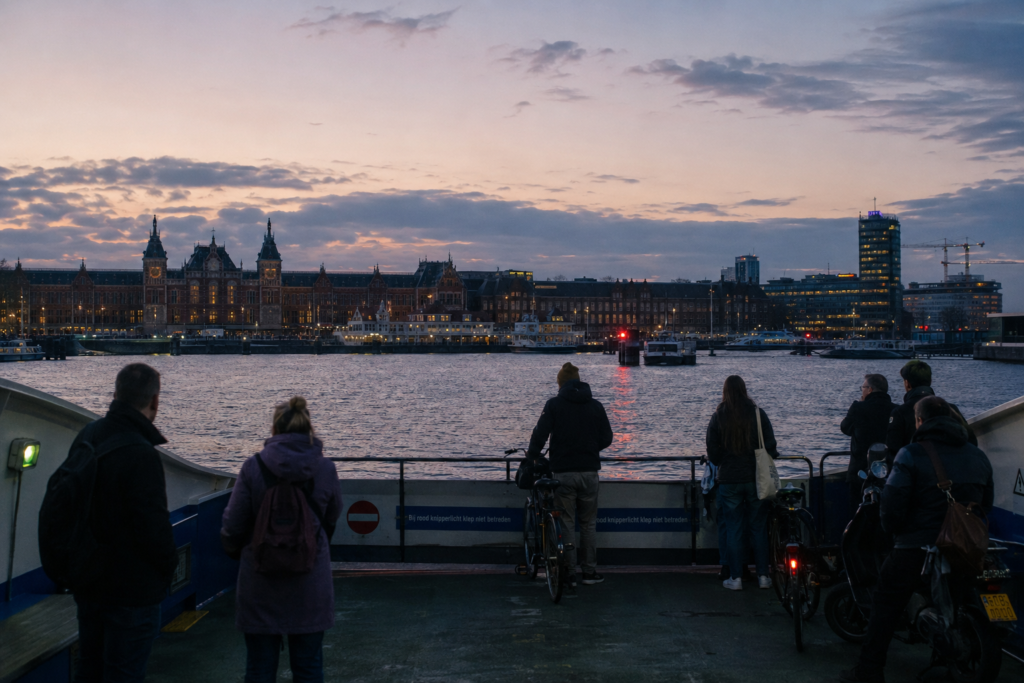
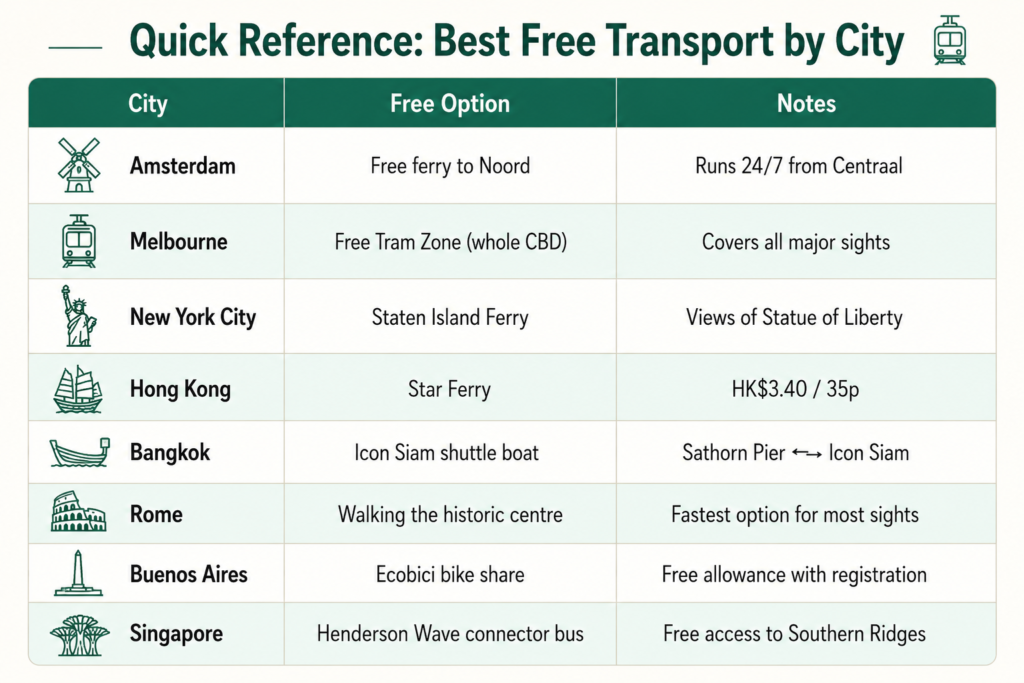
Free option: The free ferry from Amsterdam Centraal to Amsterdam Noord runs 24/7. It takes 3 minutes and crosses the IJ river — a genuinely useful and atmospheric crossing that many tourists miss.
Berlin, Germany
Berlin is huge — unlike Paris or Amsterdam, you genuinely need transport to get around. The good news is the BVG system (U-Bahn, S-Bahn, tram, and bus) covers the whole city on a single ticket type, and tourist day passes are reasonably priced.
Best buy: Berlin WelcomeCard — includes unlimited transport and discounts at 200+ attractions. Available for 2, 3, 4, 5, or 6 days.
Budget option: A standard 24-hour ticket (Tageskarte) costs around €9 and covers the entire AB zone (which includes almost everything tourists visit). No discount perks, but no premium either.
Free option: The Tempelhof airport (now a public park) is reachable on a standard BVG ticket — it is not free transport, but as one of Berlin’s most unusual free attractions it is worth planning into a day that includes transport.
Rome, Italy
Rome’s public transport is not its strongest suit, but the bus network is comprehensive and cheap. The Metro has only two main lines — useful for reaching specific sites but not the backbone of getting around the city.
Best buy: 48-hour or 72-hour tourist tickets cover all buses, trams, and Metro. Available from tabacchi (tobacconists) across the city — far easier than hunting for a ticket machine.
Free option: Rome’s historic centre is genuinely walkable — the Colosseum to Piazza Navona is about 25 minutes on foot. Walking is often faster than waiting for a bus in heavy traffic.
Asia
Tokyo, Japan
Tokyo’s public transport system is famously reliable, clean, and — by major world city standards — extremely affordable. The network is also genuinely complex, with JR lines, Tokyo Metro, Toei Subway, and various private rail companies all operating independently.
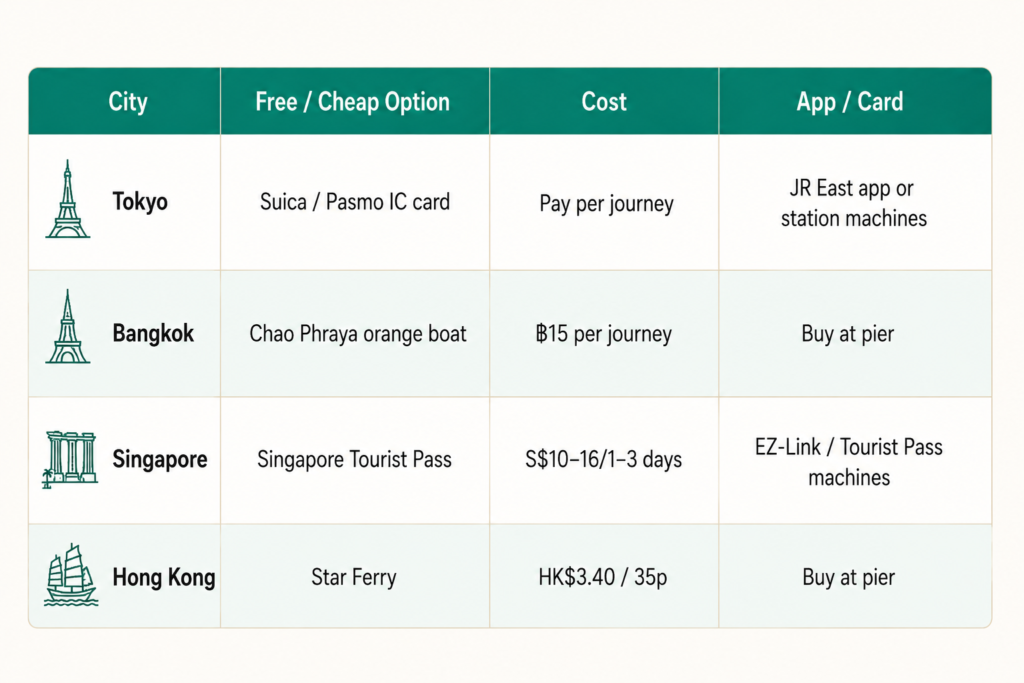
Best buy: A Suica or Pasmo card (IC cards, similar to London’s Oyster) is the single most useful transport item you can own in Japan. Load it with cash and use it on almost every rail, subway, and bus line in the country. No tourist surcharges.
Tourist option: Tokyo Metro 24/48/72-hour passes cover unlimited rides on all Tokyo Metro lines. At around ¥600–1,500 depending on duration, these are good value if you are making multiple Metro journeys per day.
Free option: The Toei Arakawa tram line (Tokyo Sakura Tram) is one of only two surviving traditional tram lines in Tokyo. A single ride costs ¥170 — very cheap — and the route through Arakawa is a genuinely local experience that most tourists skip.
Bangkok, Thailand
Bangkok’s transport picture has improved enormously in the last decade. The BTS Skytrain and MRT Metro cover the main tourist and business areas, while the Chao Phraya Express Boat offers a scenic and cheap alternative for riverside sights.
Best buy: BTS Rabbit Card (stored value) avoids single-journey surcharges and works across all BTS lines. Top it up and use it for the duration of your stay.
Free option: The free shuttle boat operated by Icon Siam shopping mall runs between Sathorn Pier (near BTS Saphan Taksin) and the mall. It is not marketed as a tourist service but it provides free river transport between two key points and the ride is genuinely pleasant.
Budget option: Chao Phraya Express Boat (orange flag) runs the full length of the riverside for around ฿15 (about 35p). Wat Arun, Wat Pho, and the Grand Palace are all accessible from river piers.
Singapore
Singapore’s MRT and bus network is the cleanest and most efficient in Southeast Asia. It is also one of the easiest for tourists to navigate.
Best buy: An EZ-Link card or Singapore Tourist Pass. The Tourist Pass (1, 2, or 3 days) gives unlimited MRT and bus travel — good value if you are moving around the city on multiple days.
Free option: The free Shuttle Bus service operates in the central business district and Marina Bay area on weekdays, but the most useful free option for tourists is the free connector bus service between Harbourfront and the Southern Ridges — a useful link if you are walking the ridge parks.
Hong Kong
Hong Kong has one of the world’s most comprehensive and affordable transport networks. The MTR is fast and reliable, and the Octopus card is accepted almost everywhere — including convenience stores.
Best buy: Airport Express Tourist Octopus card — includes the Airport Express journey plus three days of unlimited MTR travel and various retail discounts. Very good value if you are arriving by air.
Free option: The Star Ferry between Tsim Sha Tsui and Central or Wan Chai costs just HK$3.40 (about 35p). It is one of the world’s great cheap rides — harbour views included.
The Americas
New York City, USA
New York’s subway runs 24 hours a day, 7 days a week — one of the few metro systems in the world that does. Since 2023, the OMNY contactless payment system has replaced the MetroCard as the default payment method for most visitors.
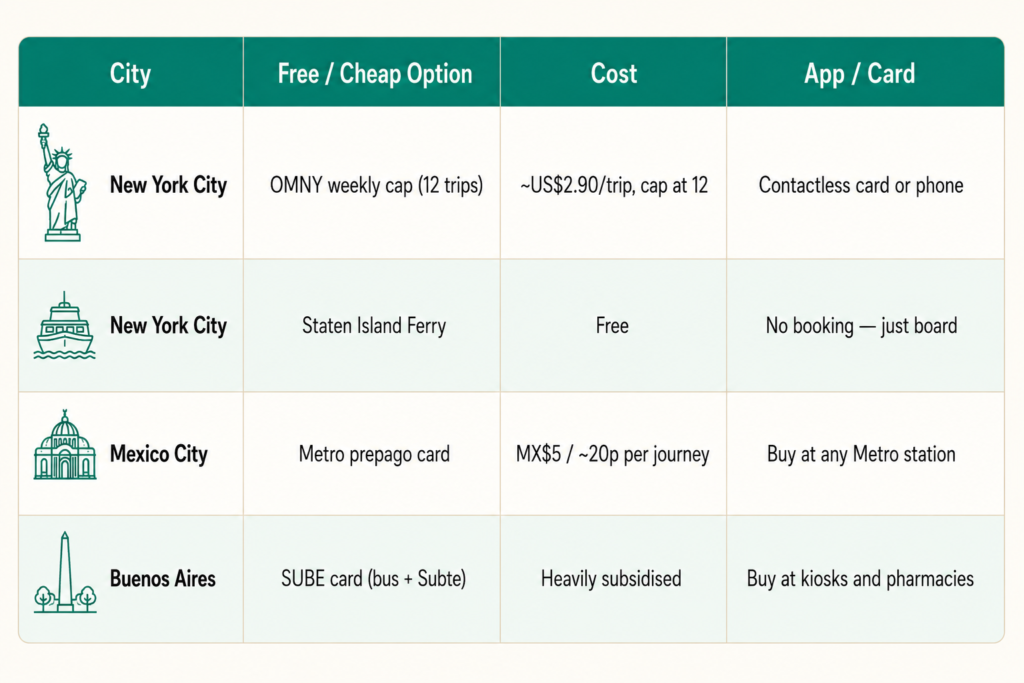
Best buy: Pay with a contactless bank card or phone via OMNY. After 12 journeys in a week, all further journeys on that card are free — effectively a weekly cap. This is the best value option for most tourists visiting for 5+ days.
Free option: The Staten Island Ferry runs every 30 minutes between Whitehall Street in Manhattan and St George in Staten Island — entirely free, 24 hours a day, with views of the Statue of Liberty and the Manhattan skyline included. One of New York’s best free experiences.
Free route: The M15 Select Bus on First and Second Avenue is a standard city bus — cheap, slow, but it covers the length of Manhattan’s east side. SBS buses board at all doors.
Mexico City, Mexico
Mexico City has the third-largest metro system in the Americas by daily ridership, and it is remarkably cheap. A single Metro journey costs around MX$5 — approximately 20p or 25 cents.
Best buy: Buy a Metro card (tarjeta de prepago) at any station and load it with cash. No tourist card is needed — the standard fare is already extremely cheap.
Free option: The Metrobús line 4 runs from Buenavista to Ciudad Universitaria via many central areas — it is not free, but at around MX$6, it is effectively free by any meaningful measure.
Buenos Aires, Argentina
Buenos Aires has a good Metro system (the Subte), extensive bus network, and remarkably cheap transport costs for international visitors, especially given current exchange rates.
Best buy: A SUBE card covers all buses, Subte, and some suburban trains. It can be topped up at kiosks across the city. The system-wide subsidised fares are extremely low by any international standard.
Free option: Ecobici, Buenos Aires’ public bike share scheme, offers a generous free allowance for registered users. Registration requires a local address but is straightforward to set up and gives access to hundreds of stations across the city.
Australia
Sydney, Australia
Sydney’s Opal card is the equivalent of London’s Oyster — load it with credit, tap on and off, and pay reduced fares compared to single tickets. There is also a daily and weekly fare cap that makes it very cost-effective for multi-day visitors.
Best buy: Opal card daily cap is A$17.80 (covering all trains, buses, and ferries). After eight paid journeys in a week, all further journeys are free for the rest of that week.
Free option: The 555 ferry route (Circular Quay to Manly) is not free, but at around A$9 return on an Opal card, it is one of the world’s great scenic ferry journeys — 30 minutes on Sydney Harbour, views of the Opera House and Harbour Bridge included. The F1 Manly Ferry is similarly priced. These are much cheaper than tourist harbour cruises.

Melbourne, Australia
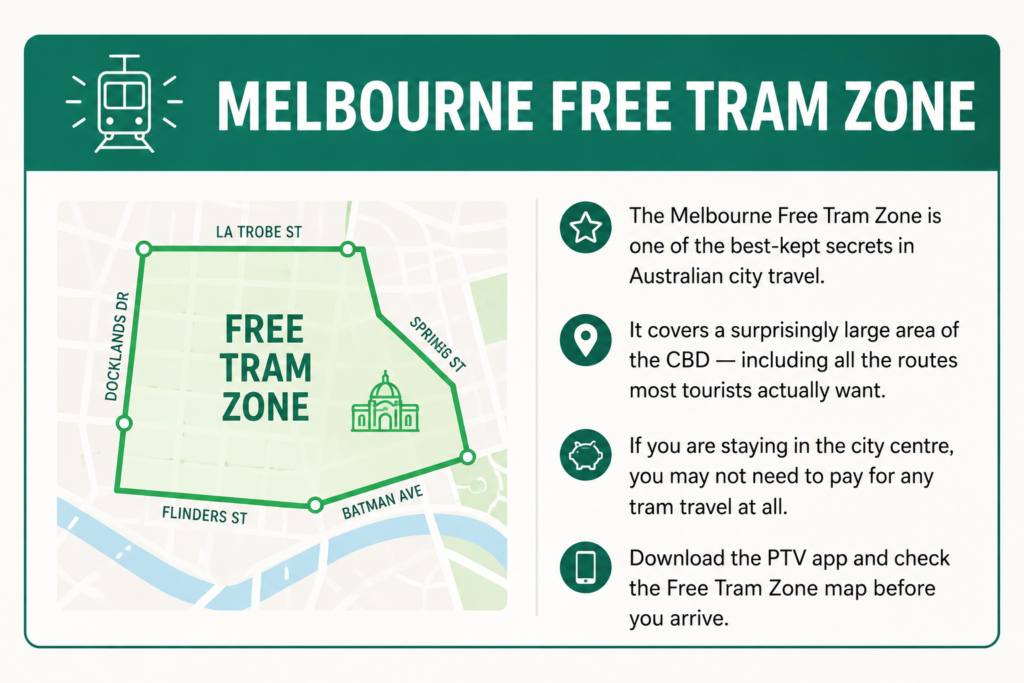
Melbourne’s free tram zone covers the entire central city area — this is genuinely free public transport in the heart of one of Australia’s largest cities, operating on a comprehensive tram network.
Free option: The Free Tram Zone covers all trams running within the City Circle loop and Melbourne’s central city streets. No card, no ticket, no charge — just board. This zone covers Federation Square, the MCG, Queen Victoria Market, and virtually every major inner-city sight.
Best buy (outside the free zone): A Myki card with a daily cap of A$11.20 for Zone 1+2, covering all trains, trams, and buses. Melbourne’s network is extensive and a day pass gives good access to inner suburbs.
How to Research Before You Arrive
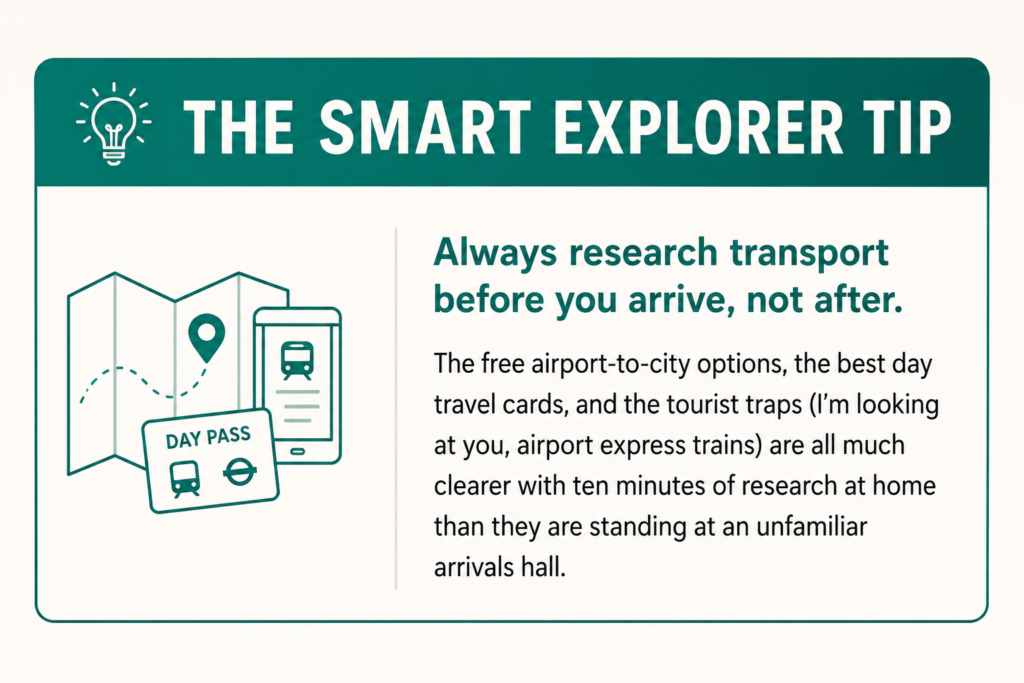
The pattern across every city in this guide is the same: the best deals are available, they’re just not marketed well. Here is how to find them for any city not covered here.
- Search for ‘[city name] tourist travel card’ — most major cities have one and it is rarely the worst option
- Check the official city transport authority website, not tourism boards — the official site lists actual prices
- Look for ‘contactless cap’ or ‘daily cap’ — London, Sydney, and NYC all have them; more cities are introducing them
- Search specifically for ‘free [city name] shuttle’ and ‘free ferry [city name]’ — many cities have free services that are poorly publicised
- Check if bike share is included in any tourist card — several European cities include it
- Google Maps now shows transport options with prices in most major cities — useful for comparing real journey costs before you travel
| RELATED ON THE SMART EXPLORER |
| → City Bike Share Programs Worldwide: The Complete Guide |
| → Airport to City Centre for Free: Budget Transport Options Worldwide |
| → Night Buses and Budget Overnight Transport: How to Save on Accommodation |
| → Tourist Travel Cards: Are They Worth It? City-by-City Analysis |
The Bottom Line
Getting around cheaply is mostly a research problem, not a money problem. Every city in this guide has affordable transport options — they are just not always the options that airport taxis and tourist coaches want you to find.
The rule I use: assume there is a good public transport option and find it before I arrive. I have never found a major city where that assumption was wrong. The Star Ferry, the Melbourne tram, the OMNY weekly cap in New York — these are not obscure hacks. They are the way locals get around, and they are almost always open to tourists too.
If you are planning a trip and your city is not covered here, drop it in the comments. I will add it to the next update.
City Bike Share Programs Worldwide: Every Major City’s Scheme Explained