

I’ve crossed Paris on a Vélib’, looped Amsterdam on a OV-fiets, and managed to dock a Santander Cycle in London without getting honked at more than twice. City bike share is one of the best-kept budget secrets in European travel. It costs almost nothing, it puts you exactly where you want to be, and it gets you off the tourist bus and into the actual city.
This guide covers seven European cities with strong bike-share schemes, what each one costs, how to use it, and where the annoying bits are — because there are always annoying bits.
Why Bike Share Is the Budget Traveller’s Best Friend
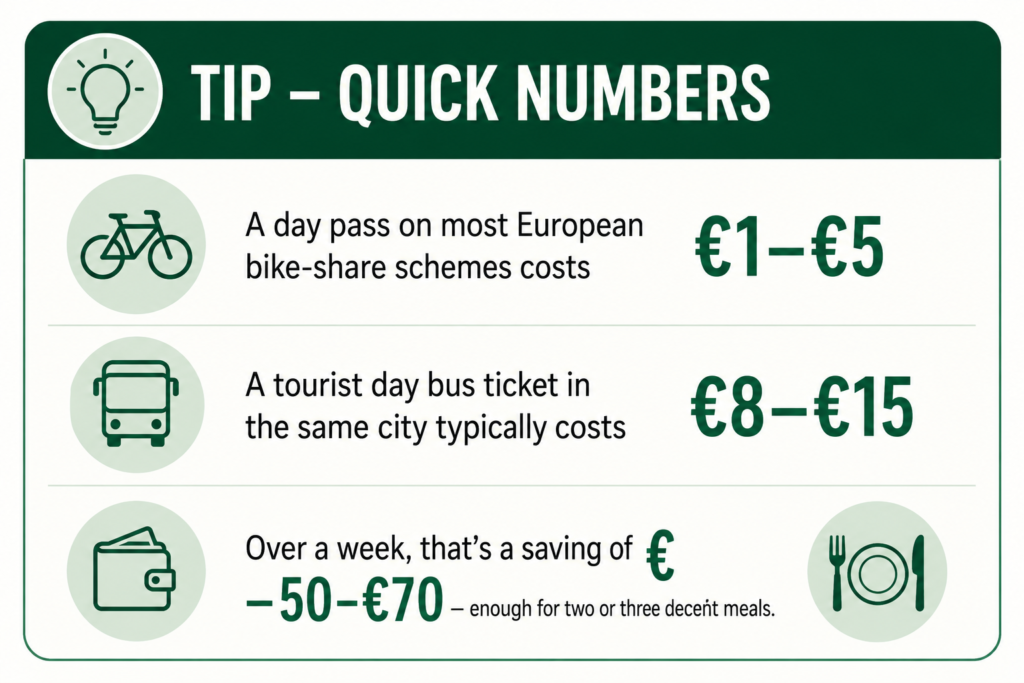
Public transport in major European cities is good. Bike share is better — for one specific type of trip: the 2–5km journey that’s too far to walk but too short to justify a metro fare. That’s the sweet spot where bike share consistently wins.
The economics are simple. Most schemes charge a flat daily or weekly fee that covers unlimited 30–45 minute rides. Take four journeys a day and you’ve already beaten the per-ride cost of the metro. The key is understanding the time limit — go over it and you start paying per extra minute, which adds up fast.
============================================================ –>Free Guide · Instant Download
50 Genuinely Free
Travel Experiences
Named, located, and verified — no catches, no upsells. Get the full guide plus one smart, specific travel idea in your inbox every month.
No spam, ever. Unsubscribe in one click.
There are three things every tourist gets wrong with bike share. First: they don’t download the app before they need the bike. Second: they don’t understand the time limit. Third: they try to find a docking station near the thing they’re visiting, rather than planning the route in advance. This guide will save you from all three.
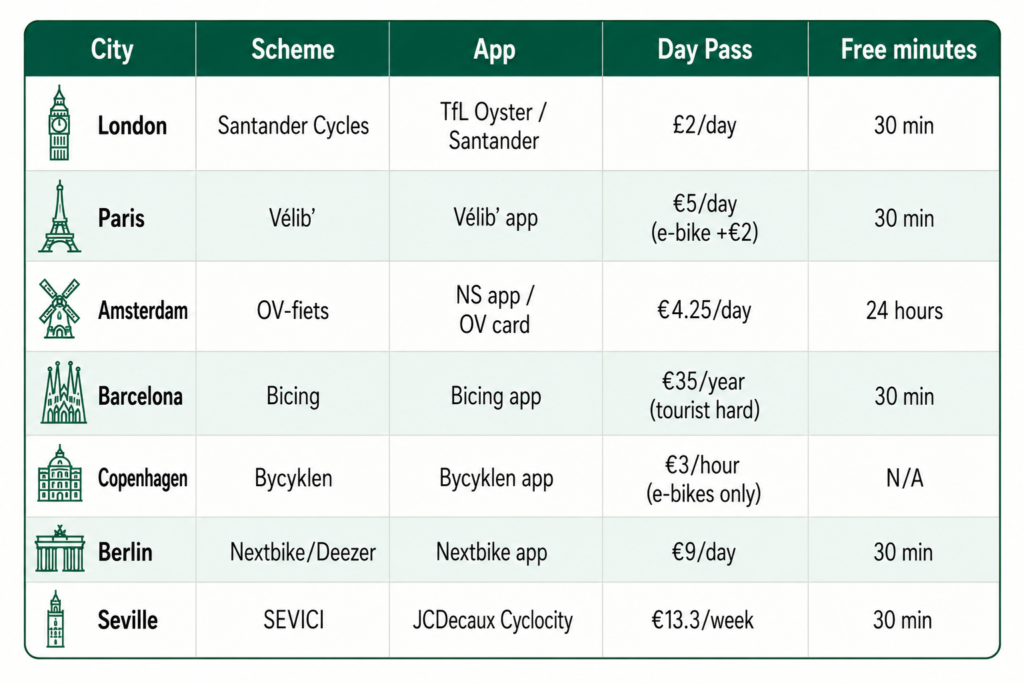
AT A GLANCE: EUROPEAN BIKE SHARE
London: Santander Cycles
Santander Cycles — still called ‘Boris Bikes’ by most Londoners — are the chunky red bicycles you’ll see docked in their hundreds across central and inner London. They’re heavy, they’re upright, and they’re indestructible. Perfect for a flat city meander, less perfect if you’re hoping to get anywhere quickly.
The basics
- Day access: £2, which gives you unlimited 30-minute journeys throughout the day
- Single journey: £1.65 for 30 minutes if you don’t want a day pass
- Extra time: £1.65 per additional 30 minutes — avoid this by docking and re-hiring at a station
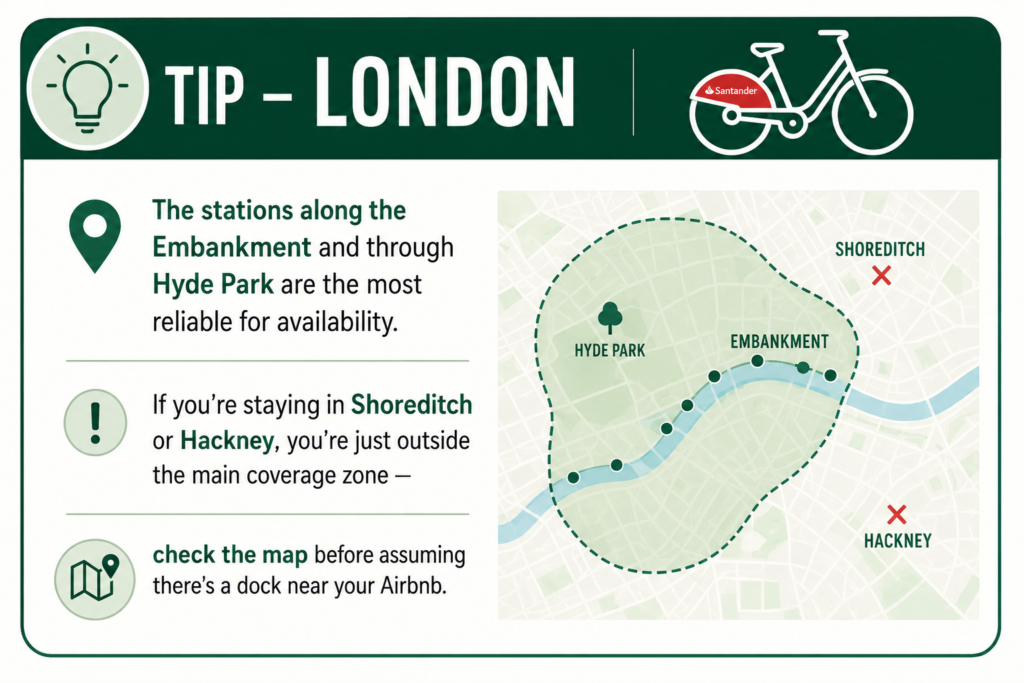
- Coverage: Central London, with good density in zones 1–2. Patchy east of Bethnal Green and south of Elephant & Castle
- Scheme size: around 800 stations and 12,000 bikes
How to use it
You don’t need an account for a casual ride. Go to any docking station, use the terminal or the app, pay by contactless or card, and get a code to release the bike. The app shows you live dock availability, which is important — popular stations empty out in the morning rush.
The TfL Go app shows Santander Cycle docks alongside tube and bus routes, which makes it easy to plan combined journeys. Download it before you go.
Best routes for tourists
- Hyde Park loop: pick up at Lancaster Gate, ride through the park, drop at South Kensington. 20 minutes, free with day pass.
- Southbank to Tower Bridge: pick up at Waterloo, ride east along the river to Tower Bridge and back. Flat, scenic, about 25 minutes each way.
- Regent’s Canal towpath: not all of it is accessible with the bikes, but the section from King’s Cross to Angel is doable and beautiful.
Paris: Vélib’ Métropole
Vélib’ is one of the oldest and most refined bike-share systems in Europe. Paris has had it since 2007, and it shows — the coverage is extensive, the bikes are well-maintained, and the Parisians are genuinely comfortable sharing the road with cyclists in a way that London drivers are still catching up to.
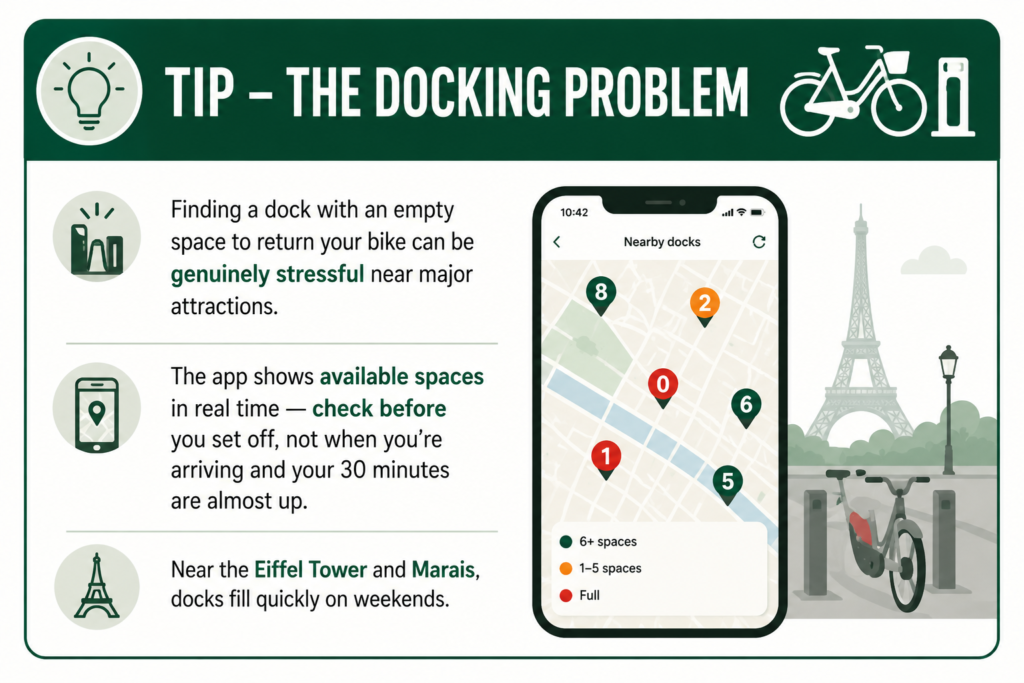
There are two types of Vélib’ bike: classic (grey, mechanical gears) and electric (blue, thumb-throttle assist). The electric ones are great. They’re also more expensive and harder to find a dock for, because everyone wants them.
The basics
- V-Libre ticket (classic bikes): €3 for 45 minutes
- V-Plus ticket (e-bikes): €5 for 45 minutes
- Day pass: €5 for classic, €7 for e-bikes — unlimited 30-minute journeys
- Weekly pass: €20, excellent value if you’re staying 5+ days
- Coverage: Paris and 60+ surrounding communes — one of the largest networks in Europe
- App: Vélib’ app (iOS and Android) — essential for locating docks with available bikes vs. available spaces
Best routes for tourists
- Canal Saint-Martin: pick up anywhere in the 10th, ride the flat towpath. The most Parisian cycling experience there is.
- Bois de Boulogne: a massive park with dedicated cycle paths, completely separated from traffic. Pick up at Porte Maillot.
- Seine riverbanks: the Berges de Seine on the left bank are car-free on weekends and excellent for a long riverside ride.
Amsterdam: OV-fiets
Here’s the thing about cycling in Amsterdam: you are not going to be better at it than the locals. The Dutch cycle everywhere, at speed, on bikes that cost €80, while carrying a toddler and a week’s groceries. Don’t try to keep up. Just ride at your own pace and enjoy being part of the most cycling-normalised city on earth.
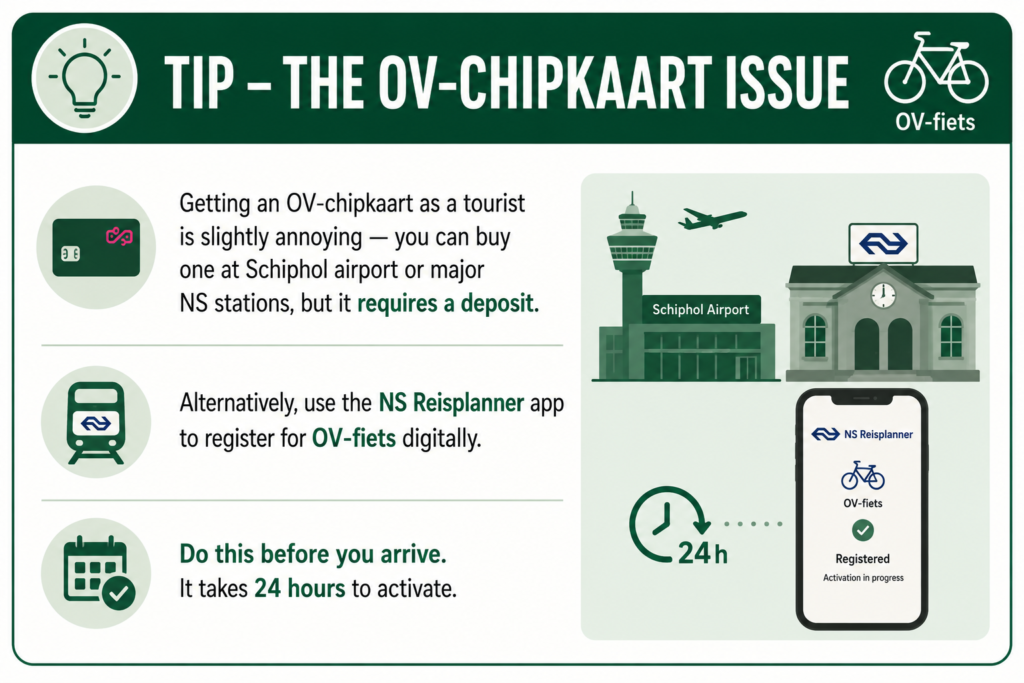
OV-fiets is the national bike-rental scheme, operated by NS (Dutch Railways). It’s designed primarily for commuters who take the train to a city and then need to cycle the last mile. As a tourist, that’s actually perfect — you arrive at Amsterdam Centraal, rent a bike from the station, and go.
The basics
- Cost: €4.25 for 24 hours — the best value of any scheme in this guide
- Pickup: NS stations across the Netherlands, including Amsterdam Centraal, Amstel, Sloterdijk, and Zuid
- Requirement: you need an OV-chipkaart (the Dutch transit card) or an account via the NS app
- The bikes: sturdy Dutch city bikes, three-speed, with a lock. Classic Dutch transport.
- No docking stations: you return the bike to any OV-fiets location — no scrambling for empty docks
Best routes for tourists
- Jordaan and Nine Streets: Amsterdam’s most beautiful residential area. Best navigated by bike — too many small bridges for buses.
- Vondelpark loop: the city’s main park, entirely flat, popular with locals and perfect for people-watching.
- Amsterdam Noord: cross the free ferry behind Centraal station and explore the art-district north shore — almost no tourists and genuinely great cycling.
Barcelona: Bicing (and the Tourist Problem)
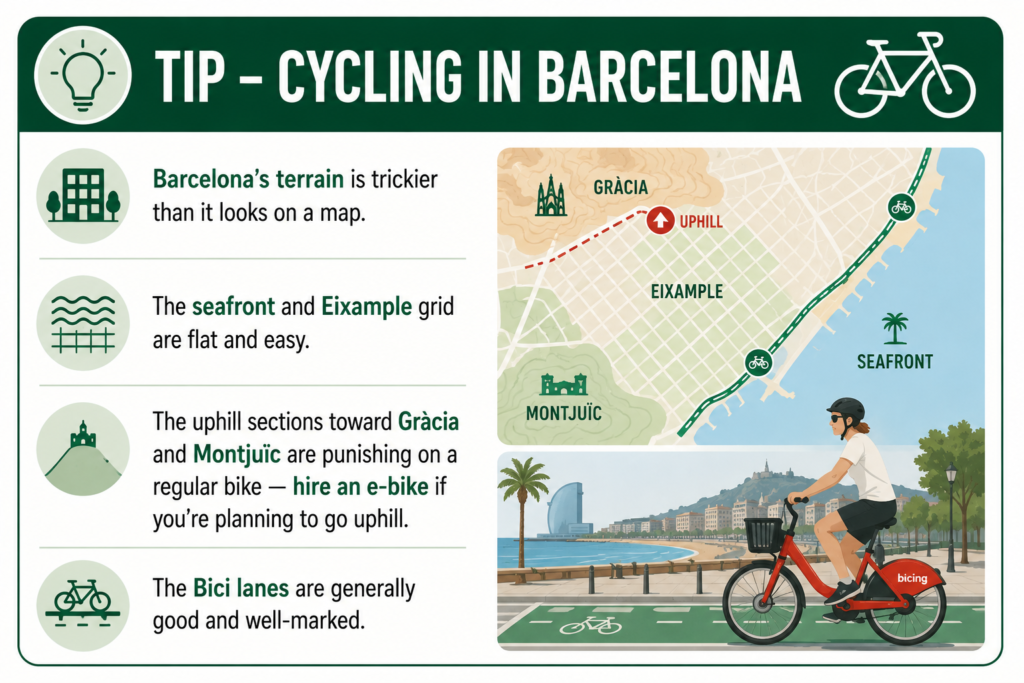
Bicing is Barcelona’s bike-share scheme. It’s excellent. It is also, technically, not designed for tourists — it’s a residential annual subscription scheme and day passes for visitors are not the norm.
Here’s the honest situation: Bicing annual membership costs €35, which is extraordinary value. But you need a Spanish address and bank account to sign up. Some travellers have found workarounds. Most just use one of the tourist-facing e-bike rental operators scattered around the city instead.
Practical alternative: Barcelona has dozens of private e-bike rental shops, particularly in the Gothic Quarter and near the seafront. Expect to pay €15–€25 for a full day on a decent e-bike. Not as cheap as Bicing, but significantly more tourist-accessible.
Copenhagen: Bycyklen
Copenhagen is regularly cited as the world’s most cycling-friendly city. The infrastructure is so good that even nervous cyclists feel safe here — dedicated cycle lanes on almost every major road, traffic lights timed to cycling pace, and an almost total absence of the ‘cyclist vs. driver’ aggression you get in other cities.
Bycyklen is Copenhagen’s smart bike-share scheme. The bikes are all-electric with an integrated tablet showing maps and real-time information. They’re brilliant pieces of engineering and noticeably more expensive than other European schemes.
The basics
- Cost: €3/hour, or approximately €24 for a full day — expensive compared to other cities
- App: Bycyklen app, available in English
- Coverage: central Copenhagen — not as extensive as Paris or London
- The bikes: genuinely impressive. The touchscreen tablet shows exactly where you are and where to return the bike.
Budget note: at €3/hour, Bycyklen adds up quickly. If you’re in Copenhagen for more than a couple of days, consider renting a standard bike from one of the many independent bike-hire shops near the main hotels (typically €12–€18/day for a quality bike). For a single afternoon of cycling, Bycyklen is convenient and fun.
Berlin: Nextbike
Berlin is a great city to cycle — it’s flat, it’s huge, and the distances between interesting neighbourhoods are exactly the right length for bike riding. Nextbike (now rebranded as Deezer Nextbike in some zones) is the main dock-based scheme.
The basics
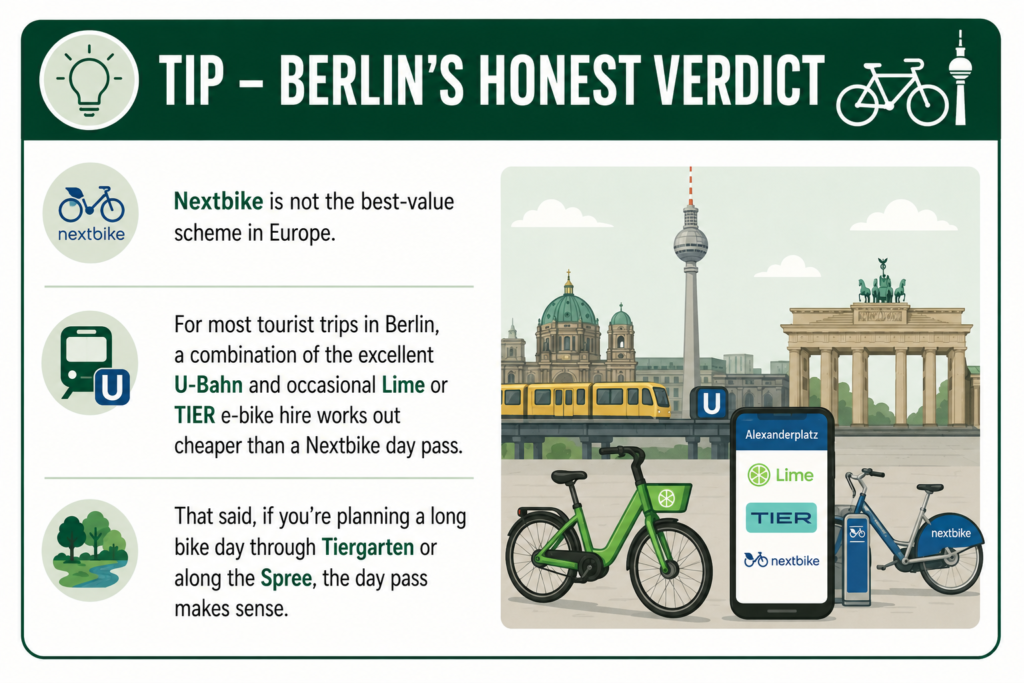
- Day pass: €9 for unlimited 30-minute rides — the most expensive in this guide for basic access
- Weekly pass: €29 — better value for a longer stay
- Alternative: Lime and TIER scooters/bikes are widely available and often cheaper for individual journeys
- Coverage: central Berlin, with reasonable density in Mitte, Prenzlauer Berg, and Kreuzberg
Best routes for tourists
- Tiergarten: Berlin’s massive central park. Flat, well-maintained paths, genuinely beautiful.
- East Side Gallery to Treptower Park: a long riverside ride along the Spree past the remaining section of the Berlin Wall.
- Prenzlauer Berg to Mauerpark: flat, interesting neighbourhood cycling through some of Berlin’s most liveable streets.
Seville: SEVICI — Europe’s Hidden Best Value
Seville doesn’t get mentioned in the same breath as Amsterdam or Paris when people talk about cycling cities, and it should. It is completely flat, has an excellent network of separated cycle lanes, and its bike-share scheme — SEVICI — is one of the best-value in Europe.
The basics
- Weekly pass: €13.33 (you pay €150 deposit, refunded when you return the card)
- Annual pass: €33.36 for residents
- Free time: 30 minutes per journey
- Extra time: €0.50–€1 per 30 minutes
- Coverage: central Seville — extremely good density in the tourist area
The deposit: SEVICI requires a €150 credit card deposit, which is refunded when you hand back the card. This is paid at an automatic terminal at the main tourist office, not at the bike dock itself. It’s a faff, but the weekly rate is so good that it’s worth the admin.

Universal Tips for European Bike Share
Before you arrive
- Download the city’s bike-share app and create an account before you land. Activation sometimes takes hours.
- Screenshot the dock map for your neighbourhood. App connectivity can be unreliable near tourist areas.
- Check whether your destination has good docking density near your accommodation — if not, factor in a 10-minute walk.
During your ride
- Set a timer on your phone for 25 minutes when you set off. Gives you time to find a dock before the free period ends.
- If a dock is full, the app will direct you to the nearest one with spaces — always check before you arrive.
- In most cities, you can pause a 30-minute journey by docking and re-hiring immediately — the timer resets. Useful for long days.
Safety
- Always check the brakes before you set off. Bike-share bikes vary in maintenance quality.
- In most European cities, helmets are not legally required for adults. Bring your own if you’re safety-conscious — the schemes don’t provide them.
- Cycle lanes are not pavements. In Amsterdam especially, pedestrians on cycle lanes are the number one irritant for local cyclists.
Which City Has the Best Scheme?
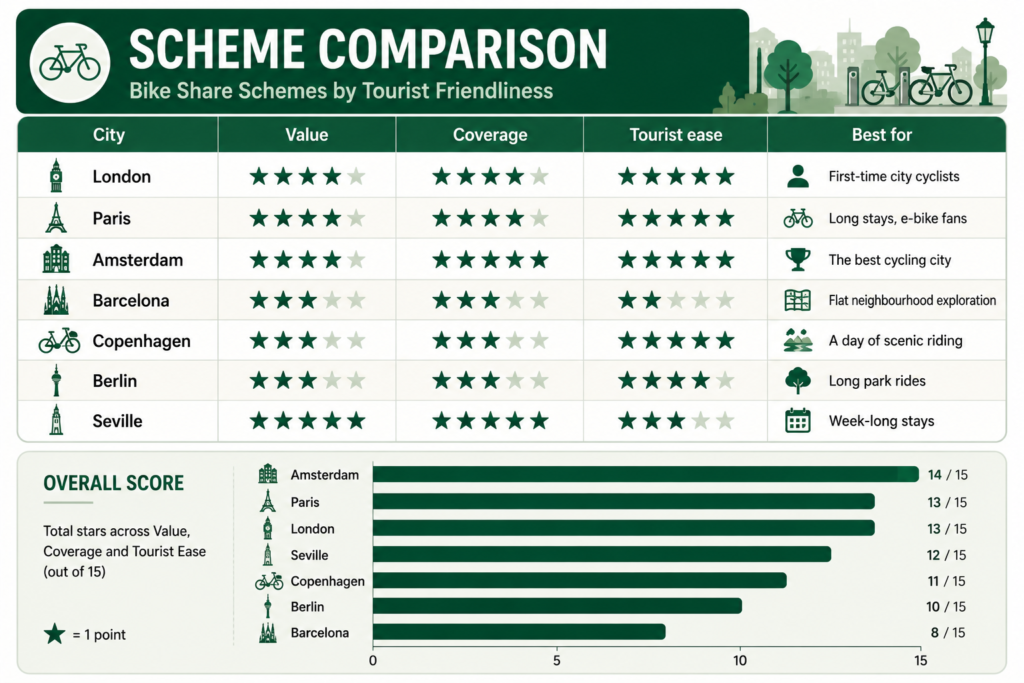
For pure value: Seville. For coverage and infrastructure: Amsterdam. For tourist accessibility and ease: London. For the best cycling experience overall: Copenhagen, if you can justify the cost.
Final Thoughts
Bike share is one of those things that sounds slightly inconvenient until you actually do it, and then you can’t believe you ever paid for a taxi in a city. The first time you glide past a traffic jam in Paris on a Vélib’, or cycle along the Seville riverfront with nothing between you and the Giralda tower, it just makes sense.
The learning curve is real — each city’s scheme has its quirks, and the first 10 minutes of figuring out an unfamiliar app while your legs are tired is not the highlight of any trip. But after that, it’s one of the most freeing ways to travel a city that exists.
Start with London if you’ve never used a bike-share scheme. Move to Amsterdam if you want to understand what cycling infrastructure done properly actually looks like.
| RELATED ON THE SMART EXPLORER City Bike Share Programs Worldwide: The Complete Guide · How to Use City Bike Share Programs: A Step-by-Step Beginner’s Guide · City Bike Share in the US: Citi Bike, Divvy, and Every Major American City · Airport to City Centre for Free: Budget Transport Options Worldwide |






City bike-sharing is one of the easiest and most affordable ways to explore European cities.