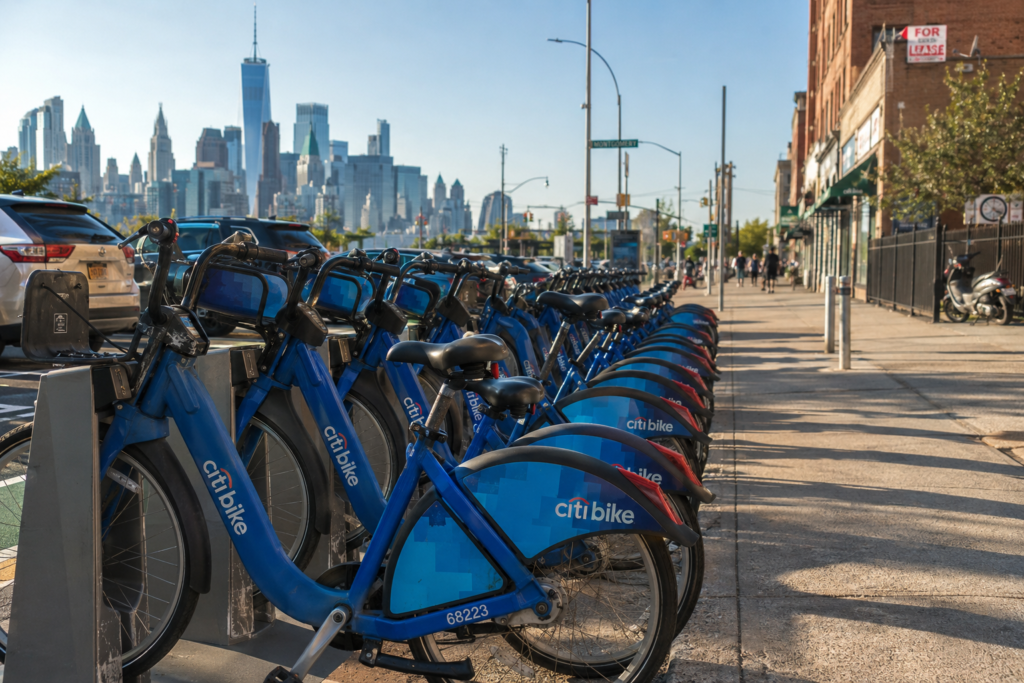
American cities have quietly built some of the best bike share networks in the world. Citi Bike in New York covers more ground than the London Underground. Divvy in Chicago has over 800 stations. Capital Bikeshare in Washington DC has been running for more than a decade. And almost every major US city now has a system — many of them cheaper than a single bus ride for a day pass.
The problem is that nobody tells tourists about them. Most visitors pay for Ubers, stress about subway maps, and completely miss that a $4 day pass would get them around the city faster and for almost nothing. This guide changes that.
What follows is a city-by-city breakdown of every major US bike share system: the app, the pricing, the coverage, and the tips that will actually save you time and money. I’ve used most of these myself. For the ones I haven’t, I’ve gone straight to the data.
✓ Quick tip: Day passes are almost always the best value for tourists. Single rides add up fast — even two single rides in a day usually cost more than the day pass. Always buy the day pass first.
============================================================ –>Free Guide · Instant Download
50 Genuinely Free
Travel Experiences
Named, located, and verified — no catches, no upsells. Get the full guide plus one smart, specific travel idea in your inbox every month.
No spam, ever. Unsubscribe in one click.
How US Bike Share Systems Work
Most American bike share systems run on one of two models: docked (you pick up and return to fixed stations) or dockless (you can leave the bike almost anywhere). A handful of systems now offer both, plus e-bikes alongside standard pedal bikes.
The practical difference matters a lot as a tourist:
- Docked systems: More reliable — you always know where to find a bike and where to return it. Coverage is more predictable.
- Dockless systems: More flexible — better for one-way trips to places without a station. But bikes can be scattered and frustrating to locate at busy times.
- E-bikes: Usually cost more (often $1–2 extra per ride or a surcharge on day passes), but they’re worth it if you’re covering long distances or dealing with hills.
The payment model is also fairly standard across the US. You download the operator’s app, add a payment card, and choose between:
- Single ride: typically $3–4, often limited to 30 minutes (overage fees apply)
- Day pass: typically $15–25, unlimited 30–45 minute rides for 24 hours
- Monthly membership: $15–25/month for residents — not worth it unless you’re staying a long time
⚠ Watch the clock: Every system has a free ride window (usually 30–45 minutes per trip). If you go over, overage fees kick in fast — often $0.10–0.15 per minute. Always dock the bike before the window ends and re-check it out if you need more time. This is the one mistake that turns a $15 day pass into a $35 one.
The Big Three: America’s Largest Networks
New York City — Citi Bike
Citi Bike is America’s largest bike share system and, in my experience, one of the most useful urban transport tools I’ve ever used. The network covers Manhattan, Brooklyn, Queens, and the Bronx — over 1,700 stations and 25,000 bikes, including e-bikes.
App: Citi Bike (iOS/Android). Also accessible via Lyft app.
Day pass: $15 (classic bikes), $25 (e-bike included). Unlimited 30-minute rides.
Best for: Getting between Manhattan neighbourhoods without paying $20 for a cab. The route along the Hudson River Greenway from the West Village to the Financial District is one of the best urban cycling routes anywhere.
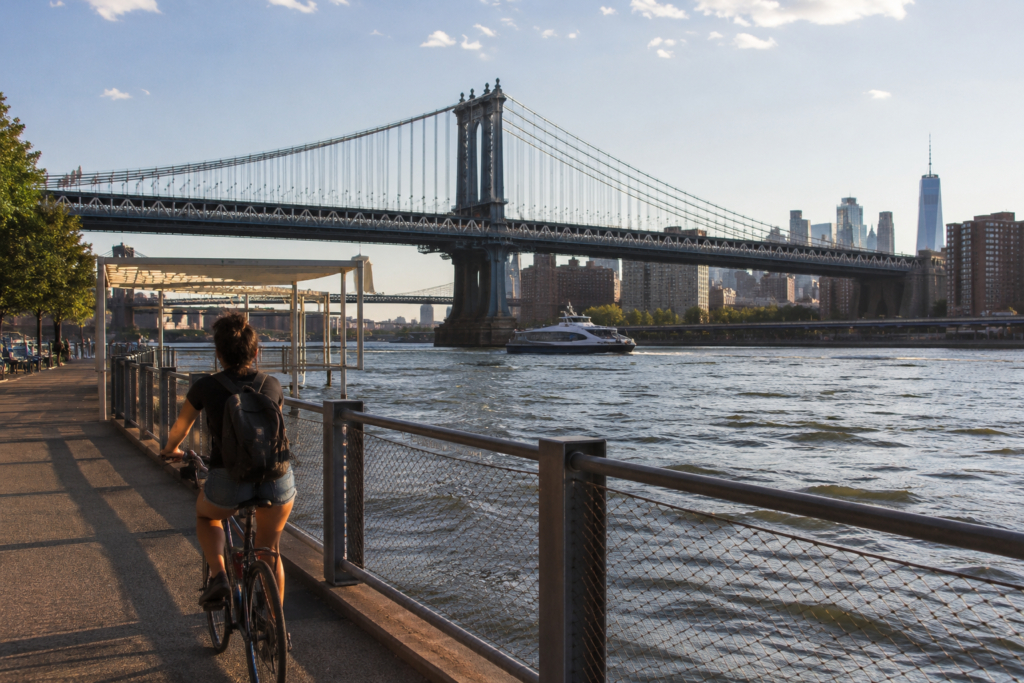
Honest assessment: Station availability can be unreliable in popular areas — Saturday morning in Williamsburg, every rack is full or every bike is gone. The app has a real-time map, so check it before you commit to a route. Midtown is the worst for this.
🚲 Insider tip: The Brooklyn waterfront route (DUMBO to Williamsburg along the East River) is completely bikeable on Citi Bike. Pick up at Old Fulton St near the bridge, drop off at N 6th St in Williamsburg. 20 minutes, zero traffic. This route has the best views of Manhattan you’ll get without paying for a boat tour.
Chicago — Divvy
Divvy is Chicago’s bike share system, operated by Lyft. It’s extensive — over 800 stations across the city — and the city’s flat terrain makes it one of the easiest places in America to actually use a bike share system.
App: Divvy (iOS/Android), or the Lyft app.
Day pass: $16.50 (classic bikes). E-bike rides cost an additional $0.20/minute.
Best for: The Lakefront Trail. 18 miles of traffic-free cycling along Lake Michigan. Pick up a bike near Navy Pier and head north to Lincoln Park or south to Hyde Park. This is the best free thing to do in Chicago, full stop.
Honest assessment: The Wicker Park and Bucktown areas have strong coverage. Downtown is excellent. South Side coverage drops off significantly south of Hyde Park — if you’re venturing that far, plan around it.
🚲 Insider tip: Pick up a Divvy from Millennium Park and ride the Lakefront Trail north to Lincoln Park Zoo (free entry). The whole trip takes under 30 minutes on a classic bike, and you’ll see more of Chicago than most people on a week-long trip manage.

Washington DC — Capital Bikeshare
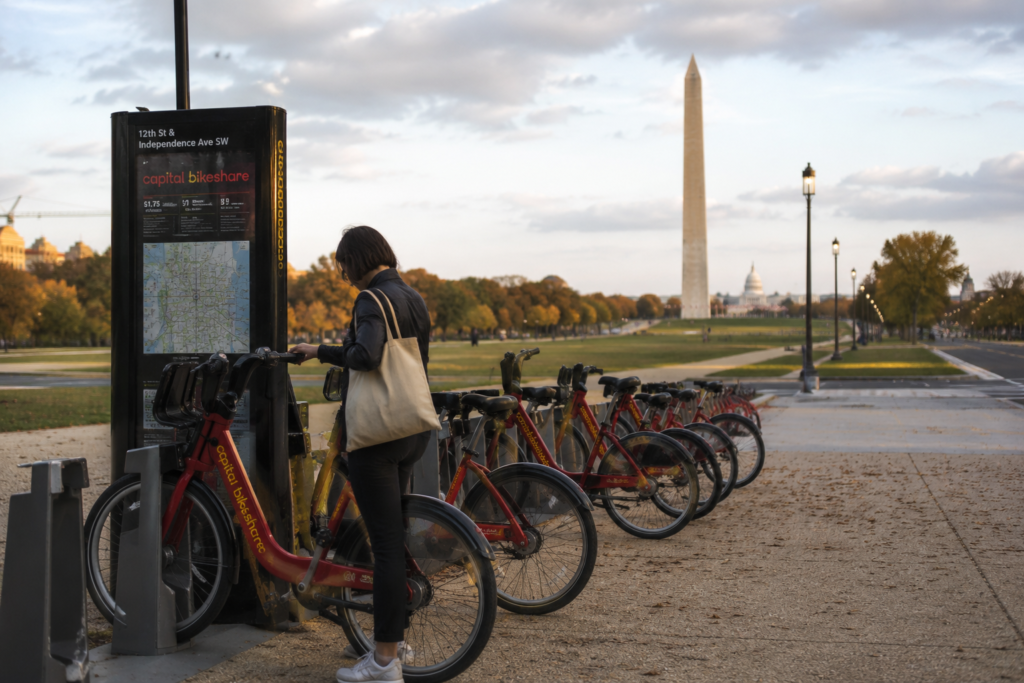
Capital Bikeshare is one of the oldest bike share systems in the US — launched in 2010 — and it shows in the infrastructure. DC’s network is dense in the central areas and extends into Arlington, Alexandria, and Bethesda in Virginia and Maryland.
App: Capital Bikeshare (iOS/Android).
Day pass: $8 for a 24-hour pass (classic bikes, unlimited 30-minute rides). One of the best day pass values in the US.
Best for: The National Mall. Every Smithsonian museum is free, and bikes are the best way to cover the distance between them. The bike paths along the Mall are dedicated and completely safe.
Honest assessment: DC is genuinely one of the best cities in the US to use a bike share. The city has invested heavily in dedicated bike infrastructure. The only challenge is returning bikes near tourist hotspots — stations near the Lincoln Memorial fill up fast on weekends.
🚲 Insider tip: Cross into Georgetown from the Mall using the C&O Canal towpath — flat, paved, car-free. It’s not on most tourist itineraries. Return via K Street for a different view of the city.
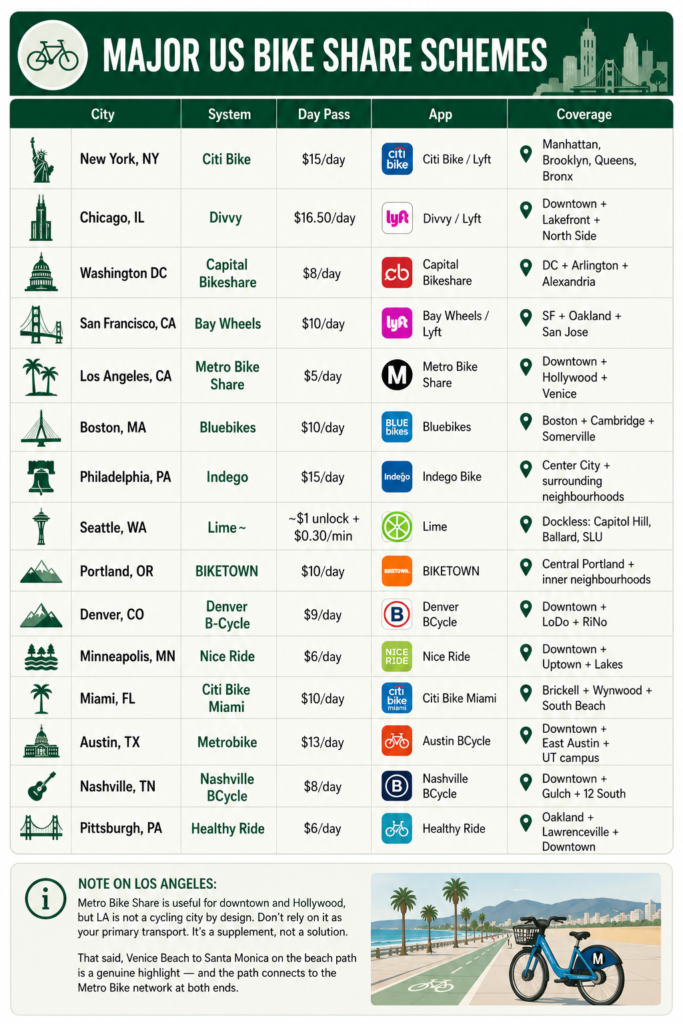
Every Major US City: Quick Reference
Here is the complete picture for every major American city with a functioning bike share system. Pricing is correct as of mid-2026 — always check the app for current rates before you ride.
Five More Cities Worth Knowing About
San Francisco — Bay Wheels
San Francisco’s bike share is operated by Lyft under the Bay Wheels brand. The city’s hills make classic bike share genuinely hard work — but the e-bikes solve this completely. The e-bike day pass is worth paying for in SF.
Day pass: $10 (classic), $20 (e-bike included). E-bike-only access: $20/day.
Best route: the Embarcadero to Fisherman’s Wharf along the waterfront, then through North Beach to Coit Tower. The city’s designated bike lanes along Market Street are now better than they’ve ever been.
🚲 Insider tip: The Bay Wheels system extends to Oakland via the Bay Bridge path — you can ride from downtown SF to Jack London Square in Oakland. Few tourists do this. It’s one of the more surprising urban cycling routes in the US.
Boston — Bluebikes
Bluebikes is Boston’s system, and it works well in the core Cambridge-Somerville-Downtown triangle. The Freedom Trail is entirely cycleable — and a bike gets you through it much faster than walking while still letting you stop at everything important.
Day pass: $10 (unlimited 45-minute rides — the longest standard window in any major US city).
The 45-minute window is the key advantage. In New York you’re clock-watching every 30 minutes. In Boston you can actually relax and explore. Harvard Square to Downtown Crossing to the Seaport — all comfortable on a single-check-out.
Portland — BIKETOWN
Portland’s BIKETOWN system is operated by Nike (yes, really) and is one of the better-designed systems in the US. The city’s cycling culture means drivers actually expect cyclists, and the bike lane infrastructure is genuinely excellent.
Day pass: $10 (unlimited 60-minute rides — the longest window in any major US system).
The route from downtown to the Hawthorne neighbourhood across the Hawthorne Bridge is the classic Portland bike experience. The bridge has a dedicated bike lane and the views of the Willamette River are worth the trip alone.
Miami — Citi Bike Miami
Miami’s Citi Bike system is separate from New York’s despite the same name. Coverage in Brickell and Wynwood is solid. South Beach is bikeable from the southern end of Brickell. The flat terrain makes it genuinely easy.
Day pass: $10 (unlimited 30-minute rides). Worth noting: Miami humidity is real — bring water.
The best use of Citi Bike Miami is the South Beach strip. A/1A along the ocean is bike-friendly, and the morning (before 9am) is spectacular — almost empty, good light, no traffic. Afternoon in Miami is brutal heat regardless.
Denver — Denver B-Cycle
Denver’s system is smaller than the others on this list but covers the most useful tourist areas well. LoDo (Lower Downtown), RiNo (River North Art District), and Cheesman Park are all connected.
Day pass: $9 (unlimited 30-minute rides). E-bikes available at a surcharge.
The Cherry Creek Trail connects downtown Denver to Cherry Creek Shopping District — 4 miles of car-free riverside cycling. Most Denver visitors never find it. It’s the city’s best-kept secret for budget travellers.
Practical Notes for Tourists
Getting the most from a day pass
The day pass is designed for multiple short trips, not one long ride. The optimal strategy is to treat bike share like a taxi: dock the bike at your destination, do what you came to do, then check out a new bike for the next leg.
- Always dock and re-check-out if you’re stopping for more than 20 minutes. It resets the clock and costs nothing extra.
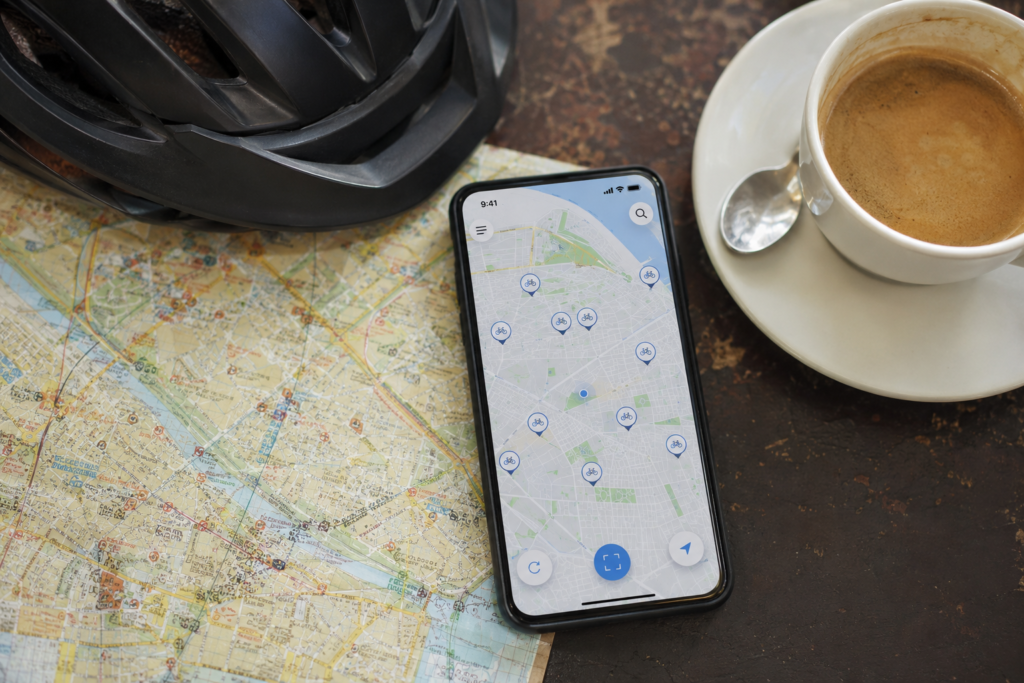
- Use the app to find stations before you start riding — not mid-ride. Plan your docking point in advance.
- E-bikes are usually worth the premium for distances over 2 miles or if you’re carrying a bag.
- If stations near tourist sites are full, check the app’s ‘return bike’ feature — it sometimes lets you do a free 15-minute extension.
Safety across US cities
American cycling infrastructure varies enormously. Chicago and DC have invested heavily in dedicated lanes. Los Angeles and Miami are more mixed. A few principles apply everywhere:
- Wear the helmet if the system provides one. Some cities (New York, Chicago) have helmets available at stations. They’re worth using.
- Assume drivers can’t see you at intersections. This is true everywhere in the US.
- Ride in bike lanes where they exist. Avoid riding against traffic on one-way streets even if it looks convenient.
- Lock to the station dock even if it looks like the bike is secure — undocked bikes can generate charges.
When bike share doesn’t work
Bike share is not the right tool for every journey in every American city. Some honest caveats:
- Los Angeles: the city is simply not built for cycling beyond specific corridors. Don’t attempt cross-city trips.
- Rain: most US cities get serious summer storms. The apps don’t warn you. Check the forecast.
- Late night: some cities (Chicago especially) have areas where cycling at night is not advisable. Use the Metro.
- Distances over 5 miles: public transit is faster and you won’t arrive sweating.
Booking Resources
Every system listed here is bookable directly through its app. There are no booking fees and no middlemen — just download the app and add your payment card before you arrive.
- Citi Bike (New York): citibikenyc.com or the Citi Bike app
- Divvy (Chicago): divvybikes.com or the Lyft app
- Capital Bikeshare (DC): capitalbikeshare.com
- Bay Wheels (San Francisco): baywheels.com
- Bluebikes (Boston): bluebikes.com
- BIKETOWN (Portland): biketownpdx.com
- Metro Bike Share (Los Angeles): metro.net/biking
- Citi Bike Miami: citibikemiami.com
If you’re planning a trip and want a compact guide to getting around cheaply — bike share, transit passes, and airport transfers — the City Transport Hub on this site covers every major US city in detail.
The Bottom Line
American cities have collectively spent billions building bike share networks that most tourists never use. The people paying for Ubers and Lyfts between attractions they could reach by bike in ten minutes are, in a very real sense, paying for your convenience.
Citi Bike in New York, Divvy in Chicago, and Capital Bikeshare in DC are all genuinely excellent systems that work reliably, cover the areas tourists actually visit, and cost less than a single cab ride for a full day of riding. San Francisco is the one place where e-bikes make the most difference — the hills are not a joke — but even there, the day pass is worth it.
Download the app before you arrive. Buy the day pass when you land. Dock before the clock runs out. That’s the whole system. Everything else is just geography.
Related reading on The Smart Explorer: City Bike Share Programs Worldwide: The Complete Guide · How to Get Around Any City for Almost Nothing · Free and Cheap Public Transport for Tourists: City-by-City Guide