Here is something nobody tells you before your first week in Bangkok: the BTS Skytrain costs about £1 a stop, a taxi in traffic can cost you an hour of your life, and a bike from the Anywheel dock outside your hostel costs 50 cents and gets you where you are going faster than either. City bike share in Asia is not a niche option for cycling enthusiasts. In most of these cities, it is genuinely the smartest way to move.

I have used bike share schemes across Southeast and East Asia over the last three years — as a primary commute tool, to reach temples that no tuk-tuk driver wants to bother with, and to cover the 800-metre gap between a metro station and wherever I was actually trying to get to. This guide covers what works, what to avoid, and exactly how to use each scheme without burning money on tourist traps.
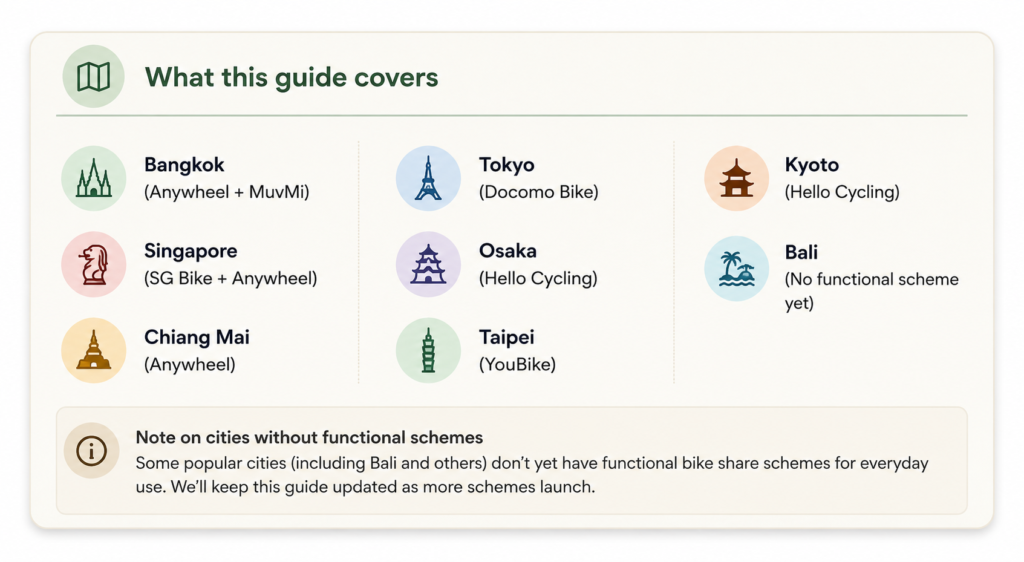
Bangkok
The Scheme: Anywheel
Bangkok has had a complicated relationship with bike share. Several early schemes collapsed due to poor infrastructure — the city’s roads are not exactly cycling-friendly — but Anywheel has found its niche by focusing on specific, bikeable corridors: the riverside area, the older neighbourhoods around Rattanakosin and Bang Rak, and the grid of streets around Lumphini Park.
The app is available in English. You scan the QR code on the bike, the lock releases, and you ride. Return it to any Anywheel dock — they are marked clearly on the app map.
============================================================ –>Free Guide · Instant Download
50 Genuinely Free
Travel Experiences
Named, located, and verified — no catches, no upsells. Get the full guide plus one smart, specific travel idea in your inbox every month.
No spam, ever. Unsubscribe in one click.
How to use it without losing your mind
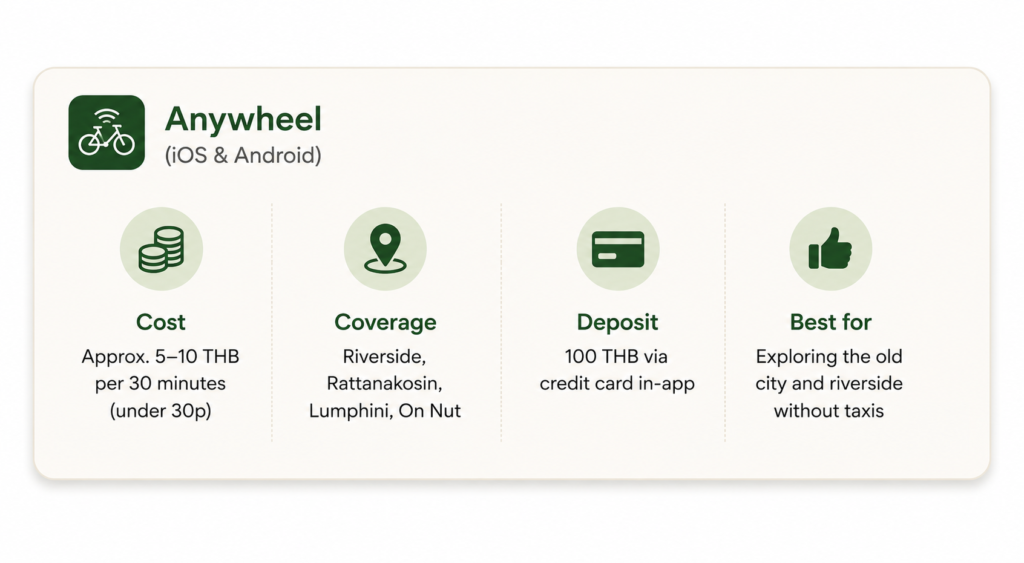
Download Anywheel before you land — the in-app registration requires a phone number verification and a card top-up, which is easier on hotel WiFi than at the roadside. Top up 100 THB to start; that gives you roughly 10 trips of 30 minutes each for under £3.
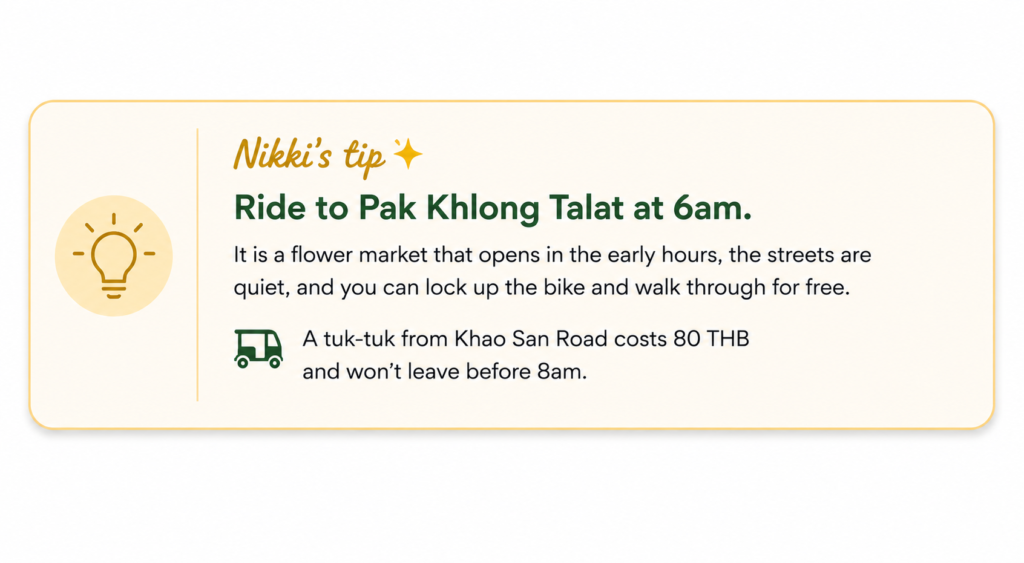
Stick to the riverside corridor and the streets around Lumphini. Avoid Sukhumvit and Silom on a bike — the traffic is aggressive and there are almost no protected lanes. The areas around Wat Pho, the Grand Palace, and the flower market (Pak Khlong Talat) are perfect cycling territory: flat, interesting, and full of spots where a taxi would drop you 400 metres short anyway.
Tokyo
The Scheme: Docomo Bike Share (Docomo Cycle)
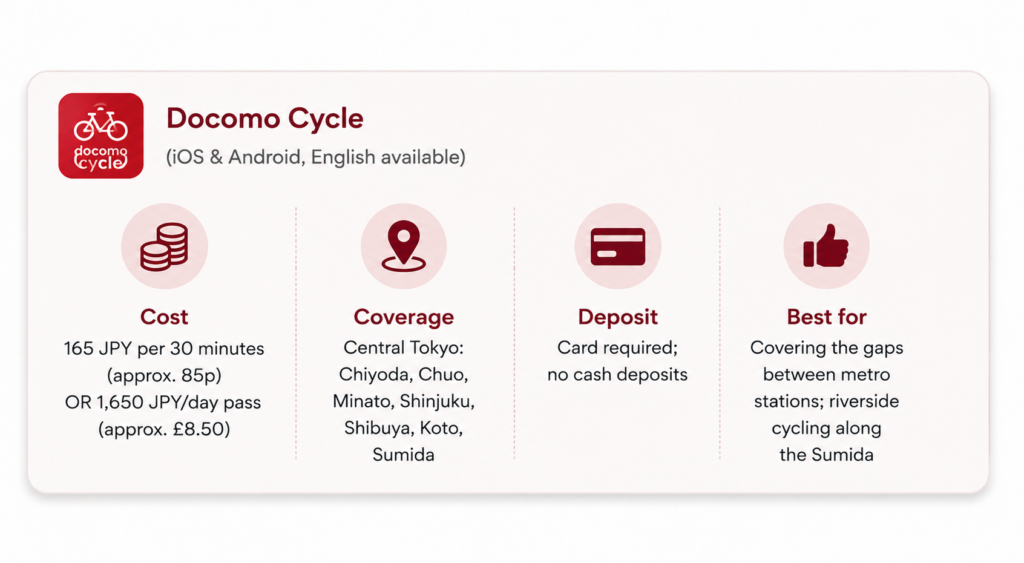
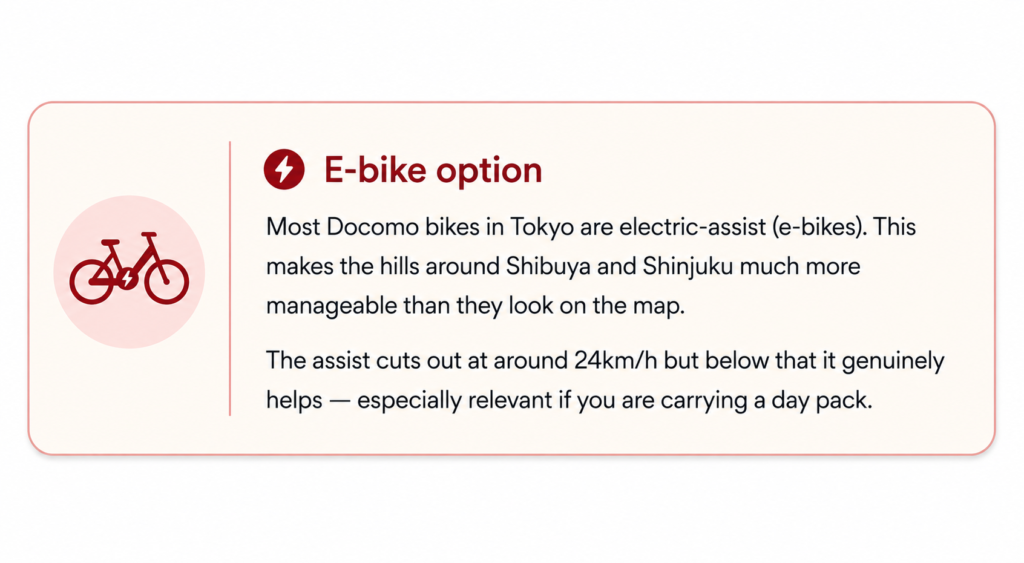
Tokyo is one of the most extensively documented cycling cities in Asia, and also one of the most confusing for visitors. The Docomo Bike Share system is excellent — genuinely well-maintained, with good app support in English — but it operates as a collection of separate regional schemes that happen to use the same infrastructure. The short version: you register once through the app, but the bike ports in Chiyoda ward are a separate zone from the ports in Shibuya, which are separate from Minato, Shinjuku, and so on.
In practice, this matters less than it sounds. Within any given neighbourhood you are cycling through, the system works seamlessly. The complication arises if you try to pick up a bike in Shibuya and return it in Shinjuku — you may be crossing zones. The app shows you available ports and which zone they are in.
Where it makes financial sense
Tokyo’s metro is one of the best in the world, but it charges per journey and those charges stack up. A day on the Yamanote Line hitting six or seven stops costs ¥200–350 each time. If you are doing a neighbourhood crawl — say, Yanaka to Nezu to Sendagi — the Docomo day pass at ¥1,650 beats two days of metro top-ups and gives you the flexibility to stop wherever you like.
The Sumida River cycling path is the single best free experience in Tokyo for cyclists: flat, well-paved, with views of the Skytree the entire way. Start at Asakusa, ride south along the river, and return via the interior streets through Ryogoku. About 14km total, doable in 90 minutes with stops, and the Docomo day pass means no per-trip charges.
Singapore
The Schemes: SG Bike and Anywheel
Singapore’s bike share scene went through a brutal shakeout in 2018–2019 when dockless operators flooded the city with poorly maintained bikes, the government clamped down with strict licensing, and three of the four major operators folded within a year. What survived is leaner, more regulated, and — for the budget traveller — genuinely useful.
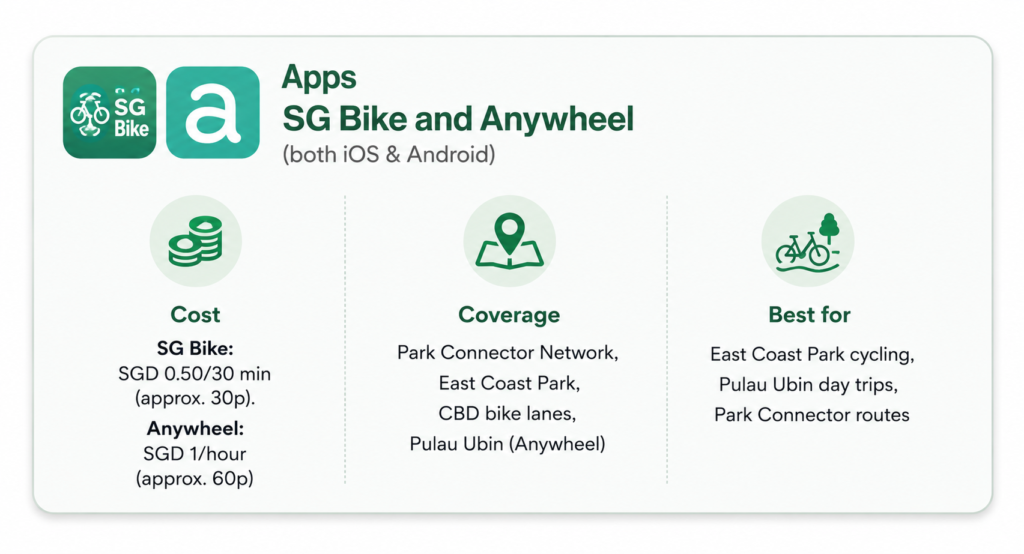
SG Bike and Anywheel are the two remaining licensed operators. Both use geofenced docking zones (you must return bikes to designated areas rather than leaving them anywhere), and both have functional English apps. Coverage is strongest in the heartland residential areas and along the Park Connector Network — the 300km+ of segregated cycling paths that link Singapore’s parks and reservoirs.
The route worth doing
East Coast Park is Singapore’s best free day out, and a bike is the only sensible way to cover it properly. The park runs for 15km along the coast — flat, shaded in parts, with beach access, food centres, and some of the least crowded spots in the city. Pick up an Anywheel or SG Bike from the docks near Bedok MRT, ride the full stretch to the Marina Barrage, and return. Budget half a day and stop at the hawker centre near East Coast Lagoon Food Village — the laksa and BBQ stingray are both under SGD 6 and are outstanding.
Osaka
The Scheme: Hello Cycling
Osaka is one of the best cycling cities in Japan — flatter than Tokyo, with a grid street layout that makes navigation intuitive, and significantly less traffic in the residential wards. The Hello Cycling scheme is the dominant operator and it works well. Ports are located near major attractions, train stations, and convenience stores (7-Eleven and Lawson locations often double as bike ports).
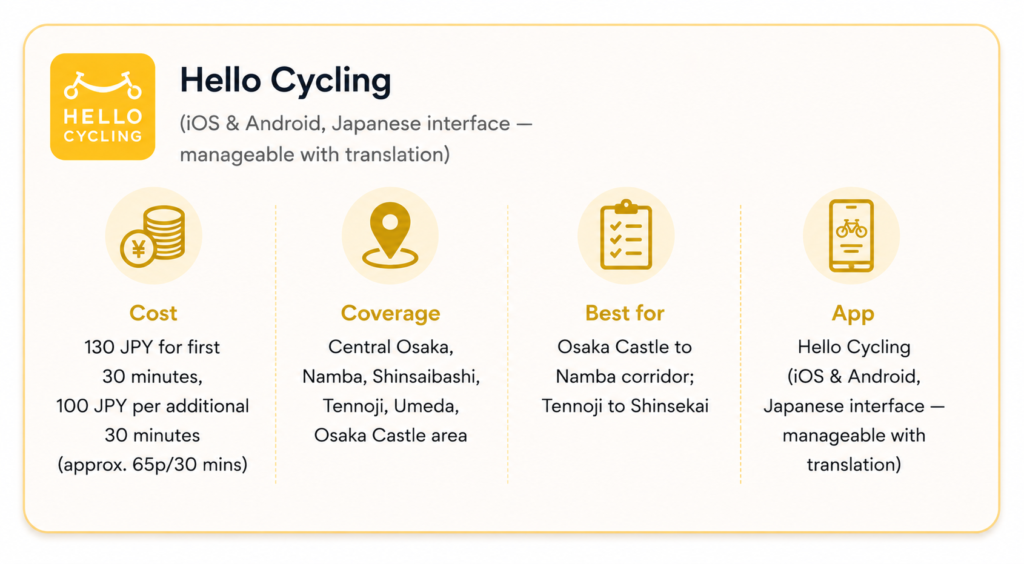
The app defaults to Japanese but navigates predictably enough with a translation tool. Registration requires a credit card and phone number. For a half-day of cycling around central Osaka — Osaka Castle, Namba, Dotonbori, the covered shopping arcades — a Hello Cycling day pass works out at roughly ¥1,500–1,800 (£7.50–9), which compares very favourably with the metro.
Kyoto
The Scheme: Hello Cycling (same app, separate city)
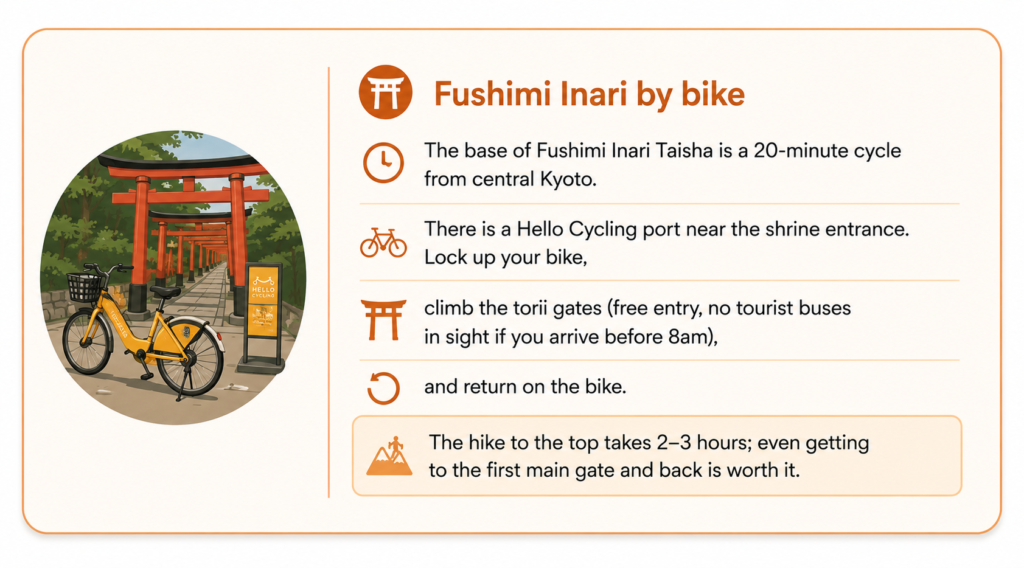
Hello Cycling’s Kyoto network is smaller than Osaka’s but covers the key areas well. The notable advantage of cycling in Kyoto is that many of the most important temples and shrines — Fushimi Inari, Tofuku-ji, Toji — are spaced along straight, relatively flat roads that connect logically by bike. The standard tourist circuit by bus involves queuing, transfers, and limited flexibility. By bike it is 20–30 minutes between most of these sites.
Avoid cycling on the Philosopher’s Path during peak cherry blossom season (late March to mid-April). It becomes a pedestrian corridor and is no place for a bike. Outside of that period, it is one of the best short cycling routes in Japan — 2km of canal path lined with cherry trees, linking Nanzen-ji to Ginkaku-ji.
Taipei
The Scheme: YouBike 2.0
YouBike is the standout bike share scheme in Asia. It is fast, cheap, extensively networked, and the bikes are well-maintained. The 2.0 version of the scheme (launched from 2021 onwards) uses a dockless-within-zones system that is far more flexible than the original. There are over 1,500 ports across the city and surrounding New Taipei area.
Registration is the only friction point for foreign visitors. YouBike historically required a Taiwanese phone number and EasyCard (the local transport card) to unlock bikes. As of 2025, credit card registration has been streamlined considerably through the updated app. Check the YouBike website for the latest method — it changes periodically.
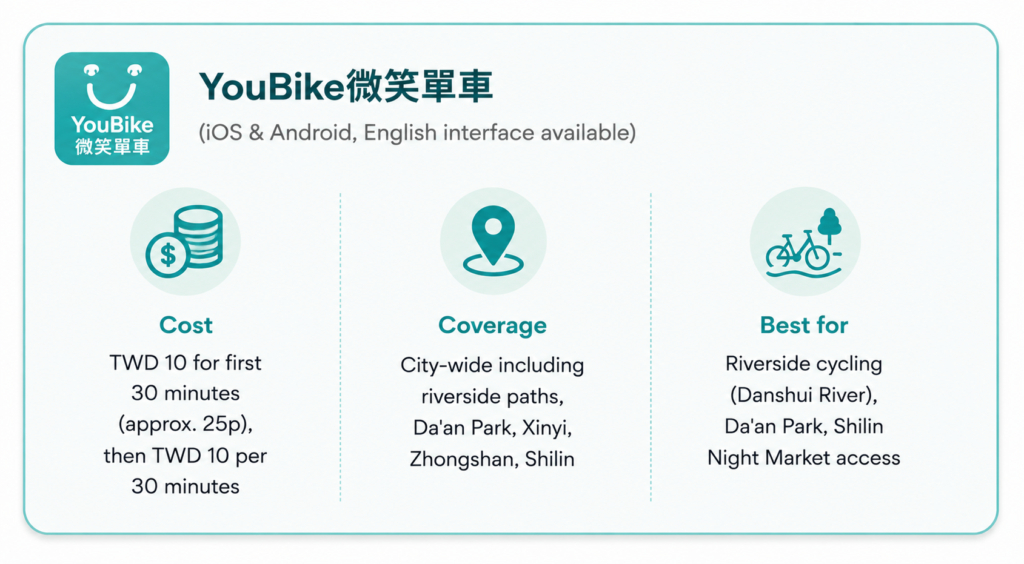
The Danshui River Cycleway is what makes Taipei a cycling destination in its own right — a 40km+ riverside path running from the city all the way to the river mouth at Danshui. It is flat, well-maintained, and almost entirely traffic-free. Budget travellers visiting Taipei should put at minimum a half-day towards this route. Take YouBike from a central port, follow the riverside signs north, and end at Danshui Old Street for seafood and the sunset. The whole day costs under TWD 100 in bike fees (under £2.50).
How to Get Around Any City for Almost Nothing
A note on cities that don’t have it yet
Not every major Asian city has a functional public bike share scheme. A few honest assessments:
- Ho Chi Minh City: Has a scheme (TNGo) but coverage is patchy and the traffic makes cycling a serious stress test. Motorbike taxis (Grab Bike) are more practical for most visitors.
- Kuala Lumpur: No integrated public bike share as of 2026. The city’s cycling infrastructure is limited and the heat and traffic make it impractical except in specific riverside areas.
- Bali (Canggu): Anywheel operates in Canggu and the surrounding area. Worth using for short hops between the rice paddies and the beach, but the main roads get chaotic. Know your route before you unlock a bike.
- Hanoi: A small bike share scheme operates in the Old Quarter (VinBike). Manageable for short distances within the lakeside area.
- Jakarta: No public bike share. Heavy traffic and limited cycling infrastructure make this a non-starter.
Practical essentials for bike share in Asia
What to download before you go
- Anywheel — works across Bangkok, Singapore, Chiang Mai, Penang, Bali
- Docomo Cycle — Tokyo
- Hello Cycling — Osaka, Kyoto, and most of Japan outside Tokyo
- YouBike — Taipei
- SG Bike — Singapore backup option
Register your card details and verify your account in each app before you arrive. Some require SMS verification, which can fail on foreign numbers with poor roaming signal.
Safety and navigation
Google Maps now shows bike share availability and routes in Bangkok, Tokyo, Singapore, and Taipei — the live port availability syncs well. Apple Maps is less reliable for this. Download offline maps via Maps.me or Organic Maps for the cities you are visiting; these show cycling routes and are more practical when you don’t have data.
In terms of safety: wear the helmet if one is provided (Singapore and Taipei ports often have them). In Bangkok and Southeast Asian cities more broadly, ride defensively — assume cars will not give way. In Japanese cities the etiquette is different: the roads are disciplined and predictable, pedestrians expect to be respected on shared paths, and cycling on the wrong side of a one-way street will get you a look from a local that conveys considerable disapproval.
Heat management
This sounds obvious but takes most people by surprise: 90 minutes of cycling in Bangkok or Singapore in August is a serious physical effort. Start early (before 9am or after 5pm), carry water, and don’t plan 20km routes on your first day. The bike schemes are best used for 15–30 minute hops between destinations, not endurance rides in 35°C heat.
Related posts on The Smart Explorer
- City Bike Share Programs Worldwide: The Complete Guide
- How to Use City Bike Share Programs: A Beginner’s Step-by-Step Guide
- Free and Cheap Public Transport for Tourists: City-by-City Guide
- Airport to City Centre for Free: Budget Transport Options Worldwide
- Budget Accommodation in Tokyo: Capsule Hotels, Hostels, and More