Most tourist travel cards are not worth buying. A few genuinely are. The difference comes down to one question: does the card beat what locals already pay?
I’ve tested passes, caps, and cards across a lot of cities, and the pattern is consistent. Cities with contactless fare capping have quietly made their own tourist cards obsolete. Cities where the airport transfer is expensive sometimes hide a genuine bargain inside a tourist card. And “city cards” that bundle transport with attraction discounts are almost never worth it for budget travellers — you’re paying upfront for museums you may never enter.
Here’s the city-by-city verdict, with 2026 prices.
The quick verdict
Now the detail — because the why is what stops you making the same mistake in the next city.
============================================================ –>Free Guide · Instant Download
50 Genuinely Free
Travel Experiences
Named, located, and verified — no catches, no upsells. Get the full guide plus one smart, specific travel idea in your inbox every month.
No spam, ever. Unsubscribe in one click.
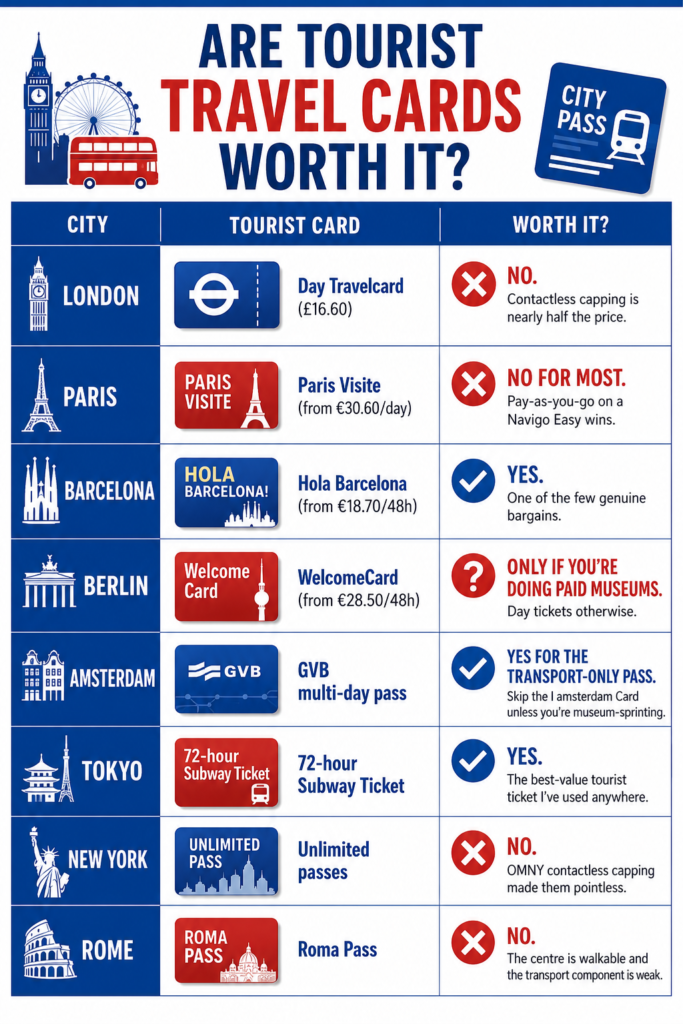
London: never buy the card
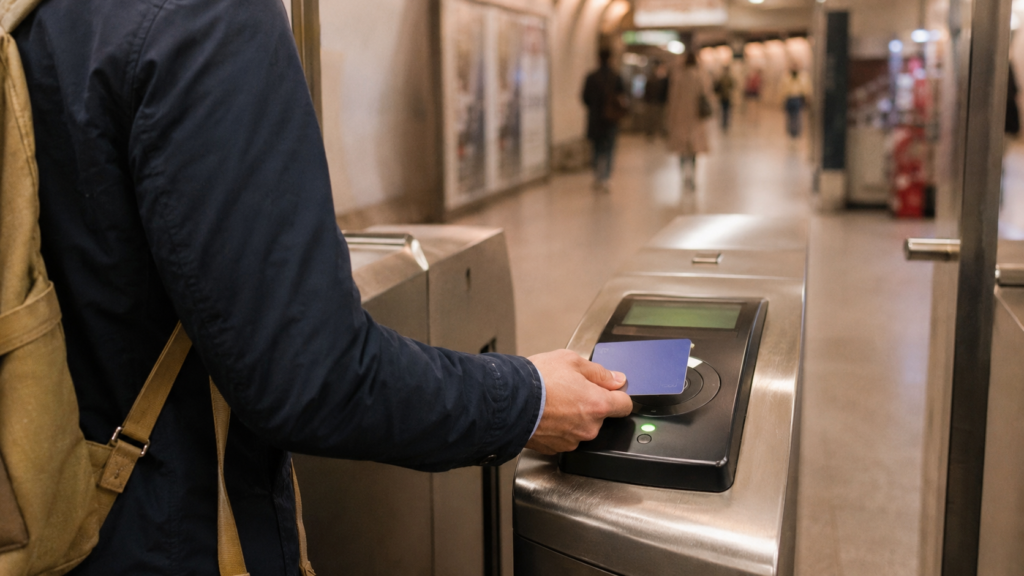
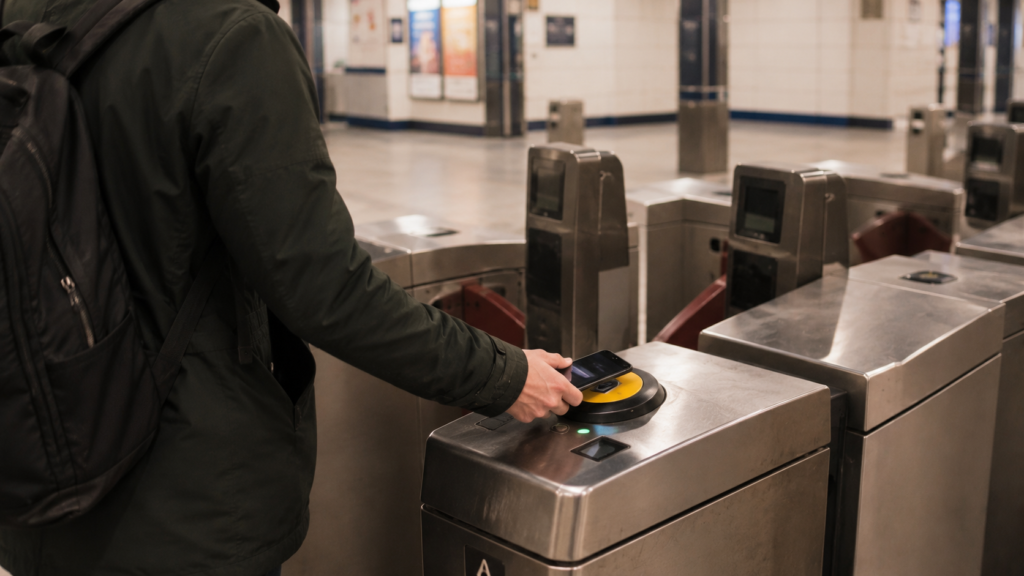
London is the clearest case on this list. The Day Travelcard for zones 1–2 costs £16.60. The contactless daily cap for the same zones is £8.90 — you just tap the bank card or phone you already own at every gate, and TfL automatically stops charging you once you hit the cap.
Same trains. Same zones. Nearly half the price. There is no calculation to do.
Two things to know so the cap actually works: use the same card or device all day (mixing your phone and your physical card breaks the capping), and if you’re bus-only, the cap drops to £5.25. Buses are £1.75 with free transfers within an hour — for short hops across central London they’re often all you need.
Verdict: skip it. Contactless capping beats every tourist product London sells.
Paris: the Visite pass is priced for someone else
Paris simplified its fares in 2025–26: a flat €2.55 metro ticket now covers zones 1–5, loaded onto a €2 Navigo Easy card or straight onto your phone. Paper tickets are gone.
The tourist product, Paris Visite, costs €30.60 for one day and €78 for five. To make the one-day pass pay, you’d need 12 metro rides in a day. Nobody does that. The average visitor takes three or four — roughly €8–10 in pay-as-you-go fares.
The pass earns its keep in exactly one scenario: you’re flying in and out of CDG or Orly (the airport journey is a separate €14 each way, not covered by normal tickets or the €12.30 day pass) and you’ll ride heavily every day. Even then, run the maths first — for most trips, two €14 airport singles plus a Navigo Easy loaded with singles still comes out cheaper.
Verdict: skip it. Buy a €2 Navigo Easy card, load single tickets, pay the airport fare separately.
Barcelona: the rare card that actually wins
Hola Barcelona is the counterexample I point to when people say tourist cards are always a rip-off. The 48-hour version costs €18.70 (€27.30 for 72 hours, cheaper still per day if you buy online with the 10% discount). Single rides are €2.55 — so far, unremarkable.
Here’s the trick: the airport metro (L9 Sud) isn’t covered by normal tickets and costs €11.80 return on its own. Hola Barcelona includes it. So the real cost of the 48-hour card, once you subtract the airport transfer you’d have bought anyway, is about €7 — for two days of unlimited metro, bus, tram and FGC. Three or four rides and you’re ahead.
One catch: it doesn’t cover the NitBus night buses (€2.65 cash to the driver) or the Aerobús.
Verdict: buy it — if you’re arriving by air and staying two days or more. Buy online before you land for the discount.

Berlin: it depends what’s on your museum list
Berlin changed its fares significantly in January 2026: the beloved 7-day pass was discontinued, singles rose to €4.00, and the 24-hour AB ticket is €11.20. If any blog still recommends the 7-day pass, it’s out of date.
The Berlin WelcomeCard starts at €28.50 for 48 hours — so you’re paying roughly €6 over two day tickets for discounts of 25–50% at 170+ attractions. Whether that’s worth it depends entirely on your itinerary. Berlin’s best sights are free: the Reichstag dome, the East Side Gallery, the Holocaust Memorial, the Berlin Wall Memorial, Tiergarten. If that’s your Berlin — and for budget travellers it usually is — the discounts have nothing to discount.
If you’re doing Museum Island, the TV Tower, and a Spree cruise, the maths flips, and the Museum Island WelcomeCard (€62/72h, includes all five museums) becomes decent value.
Staying a week or more? The €63/month Deutschlandticket covers all local transport in every German city and is unbeatable from about day eight.
Verdict: day tickets for most budget travellers. WelcomeCard only if you’ve counted at least three paid attractions on your list.
Amsterdam: buy the transport pass, skip the city card
Two different products get confused here. The GVB multi-day pass (trams, buses, metro — roughly €9.50 for 24 hours up to about €44 for a week) is honest value if you’re staying outside the centre or hopping neighbourhoods; central Amsterdam itself is small enough to walk.
The I amsterdam City Card is a different animal — €65+ for 24 hours, bundling museums with transport. It only pays if you sprint through two or three big paid museums per day, which is a schedule, not a holiday.
Verdict: GVB pass yes if you’ll actually ride; city card only for a deliberate museum blitz.
Tokyo: the best tourist ticket in the world
The Tokyo Subway Ticket — 24, 48 or 72 hours of unlimited Tokyo Metro and Toei subway travel — is sold only to visitors, and it’s the one time being a tourist gets you a better deal than locals. The 72-hour version is around ¥1,500, which is under £8 for three days of unlimited travel in one of the most extensive metro systems on earth. A single ride is around ¥180, so it pays for itself in three rides a day.
Buy it at the airport or from participating shops with your passport — you can’t get it at regular station machines. Note it covers the subway networks, not JR lines like the Yamanote loop, so plan your accommodation near a Metro station.
Verdict: buy it without hesitation. I’d plan a Tokyo trip around this ticket.
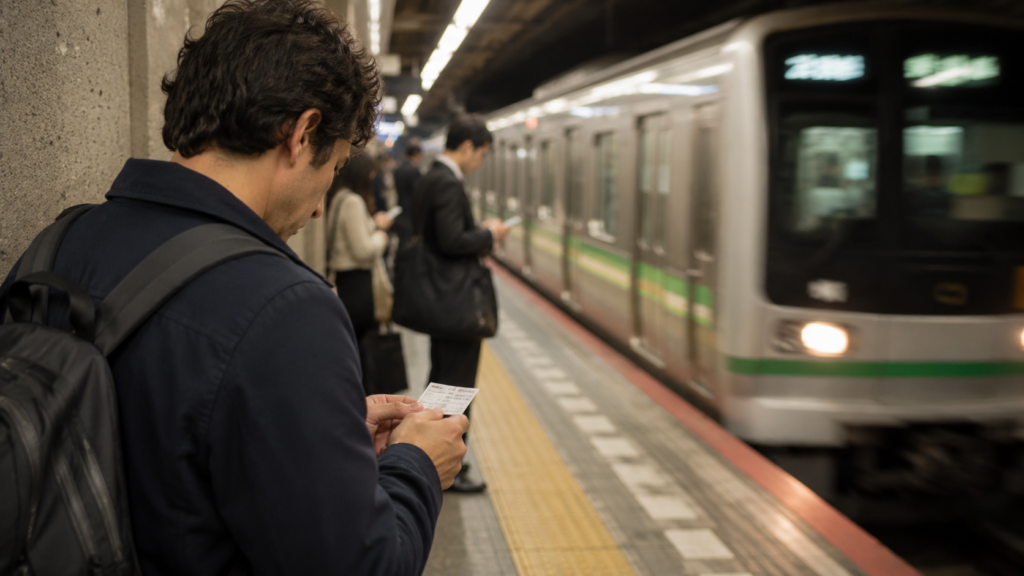
New York: capping killed the card
New York followed London’s lead: OMNY contactless capping means once you’ve paid for 12 subway or bus rides in a Monday–Sunday week with the same card or phone, the rest of the week is free. The old unlimited MetroCards are being retired, and tourist passes that resell transport at a markup make no sense against a system that caps automatically.
Verdict: skip everything. Tap your own card.
Rome: your feet are the travel card
Rome’s historic centre — Pantheon, Trevi, Piazza Navona, Campo de’ Fiori — is a walking city, and most of what you came for sits within a 30-minute stroll. The metro has two main lines that mostly skirt the centre. The Roma Pass bundles transport with museum entries, but the transport component is the weakest part, and the entries only pay if the Colosseum and one major museum were already on your list at full price.
Verdict: walk, buy single BIT tickets (€1.50) for the odd cross-town hop, and put the card money towards dinner in Trastevere.
The three rules that work in every city
After running the numbers across all of these, three rules cover almost every case:
1. If the city has contactless capping, never buy a tourist card. London and New York cap automatically; more cities are adopting it every year. The tourist card is a product designed for a fare system that no longer exists.
2. A transport-only card is worth it when it includes an expensive airport transfer. That’s the whole Barcelona trick, and it’s the first thing to check anywhere: what does the airport journey cost separately, and is it inside the card?
3. Cards that bundle attractions are a bet against your own holiday. You’re prepaying for museums at a discount and gambling you’ll visit enough of them. Budget travellers, whose best days are usually free — walking tours, markets, parks, viewpoints — almost always lose that bet.
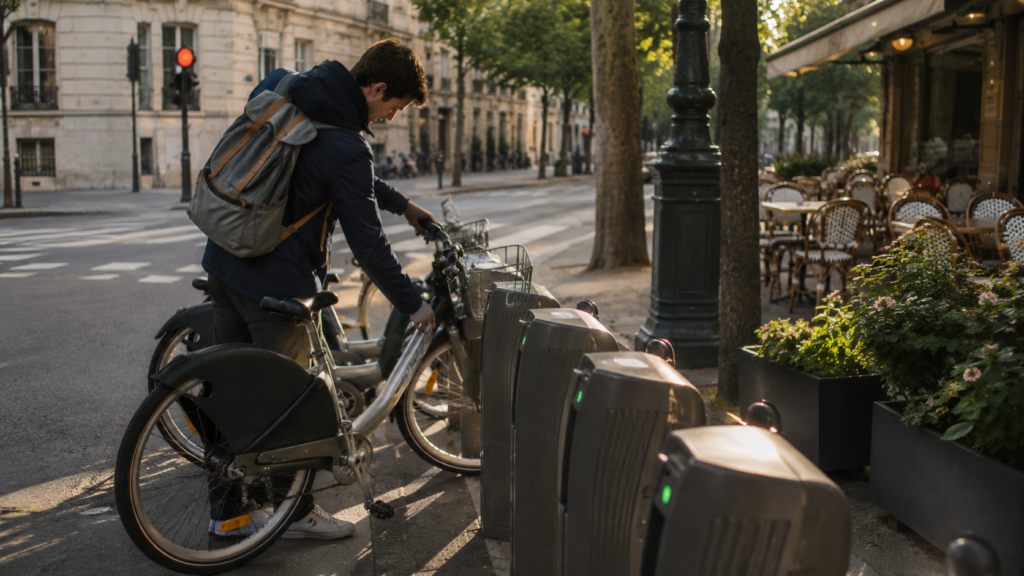
And one more thing: in a lot of these cities, the cheapest way around isn’t a card at all — it’s the bike share dock on the corner. I’ve covered every major scheme, with prices and apps, in my City Bike Share Programs Worldwide guide. In Barcelona, Paris, and Berlin, a day of bike share often costs less than two metro rides.